
Seoul's Ghost Culture vs. America: The Dead Play by Different Rules
Seoul's ghosts and America's ghosts may look familiar at first glance, but Korean gwishin, shamanic ritual and haunted American places follow different cultural rules.
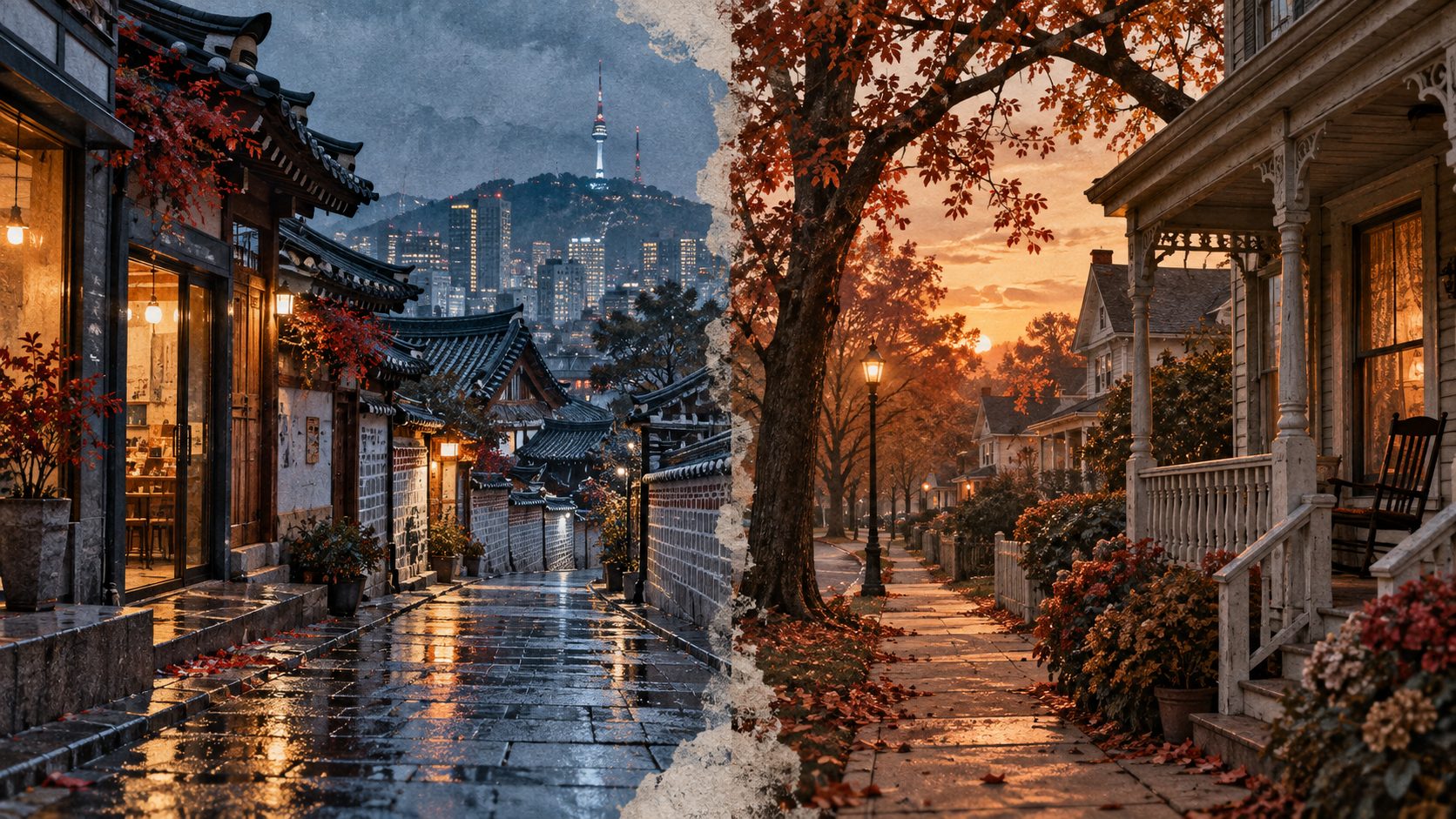
Editorial illustration, not documentary imagery.
Ghost stories exist almost everywhere, but the ghosts themselves are not culturally interchangeable.
A haunted hotel room in Seoul may sound superficially similar to one in New Orleans or Chicago: footsteps with no visible source, a figure at the end of a hallway, objects moving, or a guest waking with the sense that somebody else is in the room. Underneath those familiar details, however, Korean and American supernatural traditions often explain the experience very differently.
That contrast is central to Shawn Morrissey's 2026 book Supernatural Encounters in South Korea. According to a review in The Korea Times, Morrissey collected stories through years of interviews and his work with Seoul's Dark Side of Seoul ghost tours. The accounts include hospital and hotel ghosts, spirits attached to burial sites, mountain entities, roadside apparitions, Korean War dead, haunted ritual objects and encounters around Gyeonghui Palace.
The major difference is not that Seoul has stranger ghosts than the United States. It is that Korean supernatural culture developed from a different understanding of what a spirit is, why it remains among the living and what people are supposed to do about it.
In Korea, a Ghost Often Has Unfinished Business With Society
The Korean term gwishin (귀신) broadly refers to ghosts or spirits, particularly spirits connected with the dead.
In traditional Korean belief, death does not necessarily sever a person completely from the family or community. Research on Korean shamanism describes death as a transition in which a person moves from being a living family member to an afterlife family member. The dead can remain connected to the living, and ritual may be necessary to help restore the proper relationship between the two worlds.
That creates a different framework for many Korean ghost stories.
A spirit may remain because something went wrong: murder, betrayal, an improper burial, an unjust death, an obligation that was never completed or a ritual that was never correctly performed.
One of Korea's most recognizable supernatural figures, the cheonyeo gwishin, is traditionally the ghost of a young unmarried woman. The figure developed in a social system where marriage and continuation of the family line carried enormous importance. A woman who died before completing those expected stages of life could be imagined as remaining spiritually unsettled. Korean ghost literature has repeatedly used female ghosts to represent injustice, suppressed grievances and failures within the social order.
The ghost, therefore, is not necessarily just a monster.
It can be a problem that needs to be resolved.
Korean Tradition Includes Procedures for Dealing With the Dead
This is where Seoul's supernatural culture becomes substantially different from the typical American haunted-house narrative.
Traditional Korean shamanism has specialists specifically associated with interaction between human beings and supernatural beings: mudang, or shamans.
A gut is a ritual that can involve music, offerings, dance, spirit possession and communication with supernatural entities. Some ceremonies specifically address the dead.
The National Folk Museum of Korea describes cheondo-gut as rituals intended to help the dead travel onward while also allowing surviving relatives to cope with sudden separation and grief. Different ceremonies traditionally existed for different circumstances of death, including people who drowned or died unmarried.
In this worldview, the response to a troublesome spirit may not simply be: "Get it out of the house."
The objective can be to determine why it is still there.
It may need recognition, appeasement, ritual assistance or completion of an obligation before it can leave.
Morrissey's book even discusses mugu, ritual implements used by shamans. According to The Korea Times review, one account concerns ritual objects believed to have been improperly retired and therefore associated with dangerous spiritual activity.
That concept has no exact equivalent in mainstream American ghost culture.
American Ghosts Are More Often Attached to Places
American ghost lore certainly contains unfinished business. Murder victims return. Dead family members appear to relatives. Spirits seek justice.
But one of the strongest American supernatural templates is the haunted property.
The haunted plantation. The abandoned hospital. The old hotel. The Civil War battlefield. The Victorian mansion. The former prison. The cemetery.
Anthropological research on haunted places in the United States identifies violent death, tragedy and violations of social norms as recurring foundations for haunting narratives. The location becomes a physical boundary between ordinary life and a disturbing historical event that supposedly refuses to disappear.
Writer Colin Dickey has similarly argued that American haunted places frequently preserve cultural anxieties that society has difficulty addressing directly. Stories surrounding houses, institutions and historic properties can become distorted versions of real histories involving violence, race, wealth, mental illness or social exclusion.
Seoul has haunted buildings too. Morrissey documents hospital wards, hotel rooms and Gyeonghui Palace.
But Korean folklore more readily places spirits within a larger supernatural ecosystem rather than restricting them to a particular building.
Seoul's Ghosts Can Be Anywhere
Some of the stories documented in Supernatural Encounters in South Korea involve ghosts that move.
There are reported spirits on mountains, figures running along trails, roadside ghosts, hitchhiking apparitions and dead soldiers appearing around locations associated with the 1950-53 Korean War.
Historical Seoul folklore contains similar examples.
Historian Robert Neff documented late-19th- and early-20th-century stories of ghosts wandering streets rather than remaining inside haunted houses. One legend placed the spirit of a decapitated man near a well around Cheonggye Stream. The area around Independence Arch was associated with restless spirits and dokkaebi, supernatural beings usually translated imperfectly as goblins. Red cloth was reportedly used as protection against unwanted entities.
The supernatural landscape was therefore not limited to places where somebody had died.
A road, bridge, mountain, gate, burial site or even an object could become spiritually significant.
America Turned Ghost Communication Into an Investigation
The United States developed another distinctive tradition: attempting to prove ghosts experimentally.
Modern American paranormal investigation, with EMF meters, digital recorders, infrared cameras, spirit boxes and teams entering abandoned buildings after dark, is partly the technological descendant of a much older fascination.
Modern American Spiritualism is usually traced to the Fox sisters in New York in 1848, when Maggie and Kate Fox claimed that mysterious knocks allowed them to communicate with the dead. Seances, table-turning and professional mediums subsequently became enormously popular. Spiritualism expanded further during and after the Civil War, when enormous numbers of Americans were grieving dead relatives.
The emphasis gradually shifted from simply accepting a supernatural cosmology toward trying to obtain evidence from it.
Can the ghost produce a knock?
Can it answer a question?
Can a camera photograph it?
Can an audio recorder capture its voice?
Can an electromagnetic meter detect its presence?
That prove-it mentality remains a major feature of American paranormal entertainment.
Traditional Korean shamanism asks a somewhat different question: not necessarily whether spirits exist, but what relationship the living should have with them.
That distinction is significant.
American Spirits Are Often Filtered Through Christianity
Another difference is religion.
There is no single American supernatural worldview, but Christianity has strongly influenced American ideas about death, souls, heaven, hell, angels and demons.
Modern Americans nevertheless combine these ideas with a surprisingly broad range of supernatural beliefs.
Pew Research Center found that 65% of U.S. adults believe spirits or unseen spiritual forces exist, while 30% reported personally encountering one. About 38% said they had experienced a strong feeling that a deceased person was attempting to communicate with them. Half said cemeteries or memorial sites could possess spirits or spiritual energy.
American ghost culture is therefore not simply Christian.
It is a mixture of Christianity, 19th-century Spiritualism, Indigenous traditions, African and Caribbean religious influences, immigrant folklore, occult traditions, New Age beliefs, commercial paranormal investigation and Hollywood.
Seoul is similarly complicated.
Modern South Korea includes Buddhists, Christians, people following traditional practices and a large population with no formal religious affiliation. Korean shamanism survived centuries of pressure from political, Confucian and religious institutions and continues to adapt to modern urban life. Anthropologist Alexandre Guillemoz documented the continued presence and transformation of mudang practice inside Seoul, while scholar Liora Sarfati has examined how Korean shamanism has moved into television, museums and digital media.
A skyscraper-filled technological capital can therefore exist alongside a centuries-old system for communicating with spirits without the two necessarily being viewed as contradictory.
Seoul's Ghost Stories Often Preserve Historical Trauma
There is another major overlap between Seoul and America.
Both cultures use ghosts to keep uncomfortable history alive.
The difference is the history being remembered.
Seoul has survived dynastic violence, executions, invasion, occupation, the Korean War, dictatorship, rapid demolition and one of the fastest urban transformations in modern history.
Gyeonghui Palace demonstrates how those layers can accumulate in one location.
The palace served Joseon kings but was largely dismantled during Japanese colonial rule. Much of the site was replaced by a school, and only part of the original palace has been reconstructed. It is now frequently described in Seoul ghost-tour culture as one of the city's most haunted locations.
Morrissey reports some of his most detailed alleged paranormal encounters around the palace.
Whether those experiences have supernatural causes is unproven.
But culturally, the haunting makes sense: the physical site contains disrupted history.
American haunted battlefields, plantations, prisons and former asylums perform a comparable function. Ghosts become a way of saying that something happened here and the past has not entirely disappeared.
Korean Ghosts Are Not Simply Asian Versions of American Ghosts
The biggest mistake is to assume that every culture simply dresses the same supernatural creature differently.
A Korean gwishin is not necessarily the equivalent of an American Victorian woman floating through a mansion.
The underlying rules can differ.
In much Korean folklore, the dead exist inside a system involving family obligations, ritual status, resentment, ancestors, shamans and specific circumstances surrounding death.
American ghost culture more commonly emphasizes the haunted individual or location, personal encounters with deceased relatives, evidence gathering and the question of whether supernatural phenomena can be demonstrated.
Neither system is uniform.
And neither constitutes scientific evidence that ghosts actually exist.
Morrissey himself takes an intentionally cautious approach. According to The Korea Times, he treats the accounts as folklore and testimony rather than established fact, using terms such as allegedly and allowing witnesses to describe what they believe happened. The Dark Side of Seoul guides likewise emphasize that their material mixes documented history, folklore, urban legends and reported personal experiences.
That may be the best way to understand Seoul's supernatural culture.
The most interesting question is not simply whether its ghosts are real.
It is why Seoul's dead behave differently from America's dead, and what those differences reveal about the living cultures that created them.
Jude Cassian
Jude Cassian tracks the strange, dark, unexplained, and absurd corners of the world with independent curiosity and no political or religious spin.
Sources
Suggested Articles You Might Enjoy
8 of the Most Haunted Places in Russia
Russia has castles, estates, hospitals, and abandoned buildings wrapped in ghost stories. The legends are dark, but the evidence is more complicated.
Canada's Haunted Caribou Hotel: Contractors Report Ghostly Footsteps, Strange Lights, and a Woman Who Died in 1933
At Yukon's Caribou Hotel, restoration workers reported lights without utility power, empty-staircase footsteps, and camera glitches. The haunting remains unverified.
They Built Over a Cemetery: The Real Horror Stories Behind America's Forgotten Burial Grounds
From New York's African Burial Ground to Philadelphia, Tampa, and San Francisco, construction uncovered graves hidden beneath modern development.
Reference
https://www.koreatimes.co.kr/southkorea/globalcommunity/20260212/review-book-offers-guided-tour-through-seouls-supernatural-tales
Reference
https://www.koreatimes.co.kr/southkorea/globalcommunity/20231122/ghost-walk-sheds-light-on-seouls-dark-side
Reference
https://www.koreatimes.co.kr/lifestyle/koreanheritage/20151027/seouls-haunted-streets
Reference
https://folkency.nfm.go.kr/api/file/download/dictionary/123
Reference
https://www.kci.go.kr/kciportal/ci/sereArticleSearch/ciSereArtiView.kci?sereArticleSearchBean.artiId=ART001590874
Reference
https://www.cambridge.org/core/journals/diogenes/article/abs/seoul-the-widow-and-the-mudang-transformations-of-urban-korean-shamanism/34F57370F451B920F29AF67C3EEAE88F
Reference
https://www.jstor.org/stable/j.ctv21hrjd9
Reference
https://www.pewresearch.org/religious-landscape-study/2023/12/07/spirituality-among-americans/
Reference
https://www.smithsonianmag.com/history/the-fox-sisters-and-the-rap-on-spiritualism-99663697/
Reference
https://www.eap-iea.org/index.php/eap/article/view/65