
They Built Over a Cemetery: The Real Horror Stories Behind America's Forgotten Burial Grounds
From New York's African Burial Ground to Philadelphia, Tampa, and San Francisco, construction uncovered graves hidden beneath modern development.
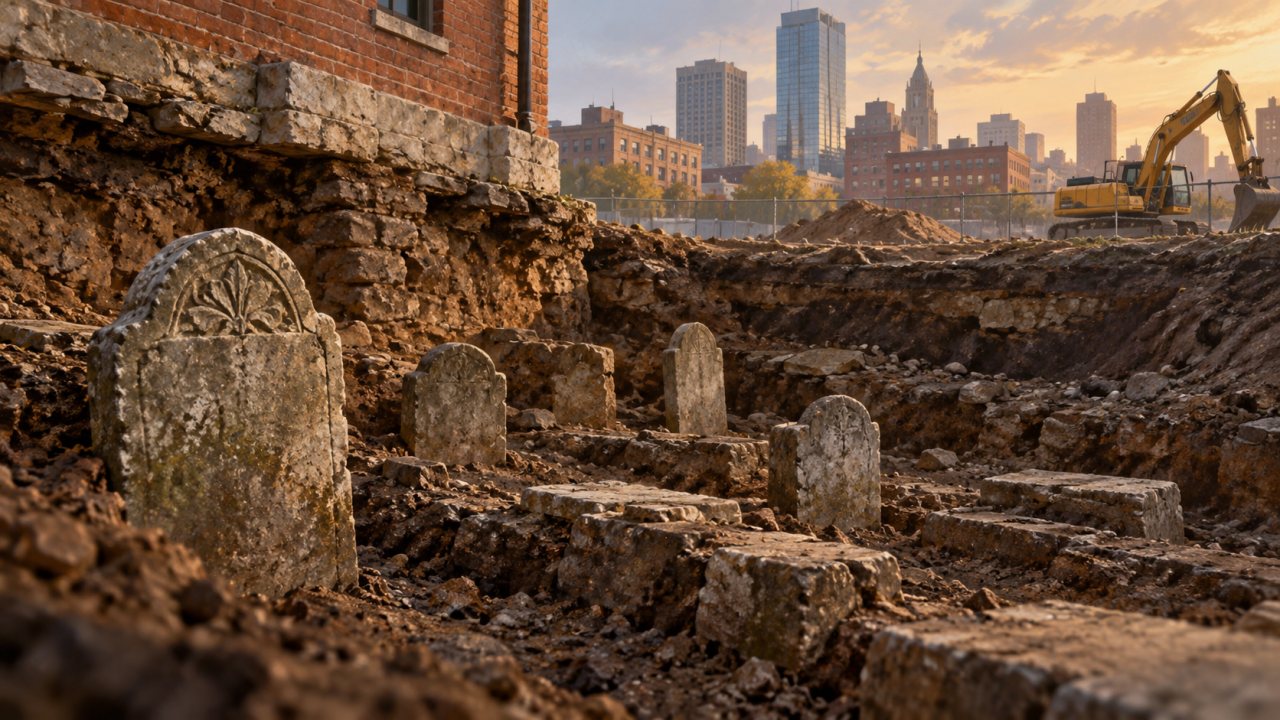
Editorial illustration, not documentary imagery.
Horror movies have repeatedly used the same terrifying premise: a house, hotel, or neighborhood is built over a cemetery, and the disturbed dead refuse to stay buried. While the hauntings are fictional, the construction mistakes behind these stories are not. From hundreds of bodies beneath a Philadelphia apartment building to a forgotten cemetery under public housing in Florida, real developers have repeatedly discovered that the ground beneath their projects contains human remains.
The Horror Movie Scenario That Actually Happens
In the 1982 horror film Poltergeist, a California family's suburban home becomes the center of increasingly violent supernatural activity.
Furniture moves without explanation. Electronic devices behave strangely. Apparitions appear inside the house.
The explanation eventually becomes clear.
The neighborhood developer had constructed the subdivision over a former cemetery. Although the headstones were removed, the bodies were left underground.
The central revelation was simple: the homes had been built directly above human remains.
That premise became one of the most recognizable ideas in supernatural cinema.
Other films, including The Amityville Horror (1979), The Shining (1980), and Pet Sematary (1989), incorporated stories about allegedly cursed land, former burial grounds, and structures associated with violent histories.
On October 30, 2020, construction journalist Peter Kenter examined this recurring theme in an article for Daily Commercial News, titled "You Built It On A Cemetery!" — Where You Build Is Just as Important as What You're Building.
Kenter used several horror movies to illustrate what happens when fictional developers fail to investigate the history of their construction sites.
But actual construction projects have uncovered situations remarkably similar to the opening premise of these films.
And unlike Hollywood's invented hauntings, the remains found beneath these buildings have been documented by archaeologists, government agencies, and forensic investigators.
New York City: 419 Bodies Discovered During Construction
In 1991, construction began on a new federal office building at 290 Broadway in Lower Manhattan.
Workers excavating the property discovered human skeletal remains buried deep below the city's streets.
Archaeologists eventually established that the site was part of a large African burial ground used during the seventeenth and eighteenth centuries.
The cemetery had been associated with New York's enslaved and free African population.
During colonial times, Africans were often excluded from established church cemeteries. A separate burial area developed outside the northern boundary of the early city.
As New York expanded, the cemetery disappeared beneath streets, sidewalks, buildings, and layers of construction fill.
Although the burial ground appeared on historical maps, its physical location had largely been forgotten.
Excavations between 1991 and 1992 recovered the remains of 419 individuals, including men, women, and children.
According to the National Park Service, nearly half of those recovered were children younger than 12.
Researchers estimated that the original burial ground had contained more than 15,000 people.
The discovery led to protests over the disturbance of the graves and the handling of the remains.
Community groups demanded that the site receive historical recognition and that the individuals buried there be treated respectfully.
Construction plans were modified, and the recovered remains were transferred to Howard University for scientific study.
On October 4, 2003, the remains were ceremonially reinterred at the preserved portion of the burial ground.
In 2006, the site became the African Burial Ground National Monument.
The discovery demonstrated how an entire historic cemetery could disappear beneath a modern city without the bodies ever having been removed.
Philadelphia: Nearly 500 Graves Beneath an Apartment Construction Site
Another extraordinary discovery occurred in Philadelphia.
In late 2016, construction crews began excavating land at 218 Arch Street for a new apartment building.
While drilling foundations and removing soil, workers uncovered human bones.
The site had once been the burial ground of the First Baptist Church of Philadelphia.
The cemetery dated to 1707 and contained the remains of people buried throughout the eighteenth and nineteenth centuries.
Historical records indicated that the cemetery had been relocated to Mount Moriah Cemetery around 1860.
For generations, people assumed the bodies had been removed.
That assumption was wrong.
The property had subsequently been used for commercial purposes, including a hat factory, an automobile repair business, and a parking lot.
When construction began, the original burial ground was no longer visible.
An archaeological team became involved after skeletal remains appeared in the excavated soil.
According to the Arch Street Project, a large drilling auger brought bones to the surface while construction crews prepared the foundation.
Further excavation uncovered numerous intact burials.
Between February and September 2017, researchers and professional archaeologists recovered the remains of nearly 500 people.
Some coffins were found deep beneath the level of the initial excavation.
The discovery prompted disputes involving archaeologists, developers, and the courts over how the remains should be documented, studied, and reburied.
Researchers examined the bones and burial artifacts to learn more about life and death in colonial Philadelphia.
The remains included people from different ages and backgrounds, reflecting the history of the early city.
For several years, the excavated remains were stored at Rutgers University–Camden.
In July 2024, nearly 500 individuals were finally reburied at Mount Moriah Cemetery.
The event took place more than seven years after construction equipment first uncovered the cemetery.
The discovery was particularly significant because the old property records indicated that the burials had already been moved.
The records did not match what was actually underground.
Tampa: An Apartment Complex Built Over a Forgotten Black Cemetery
In Tampa, Florida, residents of Robles Park Village learned in 2019 that part of their apartment complex had been built over a historic African American cemetery.
The burial ground, known as Zion Cemetery, was established in 1901.
It was among Tampa's earliest cemeteries serving the Black community during segregation.
Over time, the cemetery disappeared from public maps and local memory.
In 1951, construction began on Robles Park Village, a public housing development containing hundreds of apartments.
Part of the development extended onto the historic cemetery grounds.
For decades, residents lived in buildings situated above or immediately beside the former burial site.
In 2019, a Tampa Bay Times investigation brought renewed attention to the cemetery's location.
The Tampa Housing Authority commissioned archaeological investigations to determine whether graves remained underground.
Ground-penetrating radar revealed at least 126 anomalies consistent with buried coffins beneath the affected portion of the housing complex.
The suspected graves were located approximately four to six feet below the surface.
The Housing Authority confirmed that about 1.5 acres of Robles Park Village overlapped the original cemetery.
Officials ordered residents relocated from five buildings situated within the affected area.
Further archaeological investigations located additional probable graves on neighboring properties.
The discovery raised questions about how the cemetery had disappeared from local records and why construction had been allowed to proceed over land historically used for burials.
Historical research later identified hundreds of people associated with Zion Cemetery.
In April 2026, Tampa City Council approved a land-swap agreement intended to help preserve the historic burial ground.
The case remains an example of how urban development can conceal a cemetery for generations.
Unlike the supernatural stories portrayed in horror films, the discovery required archaeological investigation, historical research, and government action rather than paranormal explanations.
San Francisco: A Museum Built Over Hundreds of Graves
One of the most visually striking discoveries occurred beneath the California Palace of the Legion of Honor in San Francisco.
The museum, located in Lincoln Park, opened in 1924.
Before the building existed, the surrounding land had been part of San Francisco's City Cemetery.
The cemetery included graves belonging to people with limited financial resources, many buried in simple wooden coffins.
As the city expanded, the cemetery was closed and much of the land was repurposed.
Some remains were moved, but many were left behind.
During the museum's original construction, workers encountered buried bodies.
Decades later, an extensive renovation and seismic retrofit beginning in 1992 exposed additional remains.
Archaeologists uncovered approximately 750 burials associated with the former cemetery.
Human bones, intact skeletons, and redwood coffins were discovered beneath and around the museum.
Some graves had been disturbed during earlier construction, while others remained in their original positions.
According to archaeological reporting, portions of the museum's foundation were built over burial areas where removing the remains would have threatened the stability of the structure.
The discovery was photographed by artist Richard Barnes, whose images documented the contrast between the museum's elaborate architecture and the historic graves beneath it.
For decades, visitors had entered a major cultural institution without realizing that hundreds of people had been buried under the property.
The building was not merely located near an old cemetery.
Parts of it had been constructed directly over one.
Why Do Developers Keep Finding Forgotten Cemeteries?
The repeated discoveries are partly the result of incomplete historical records.
Older cemeteries were not always documented according to modern surveying standards.
Graves could be marked with wooden crosses, temporary markers, or inexpensive stones that deteriorated over time.
Families sometimes relocated, churches closed, and burial societies disappeared.
Even when records indicated that a cemetery had been moved, relocation efforts were not always complete.
The Philadelphia case illustrates this problem.
Records suggested that the First Baptist Church burial ground had been cleared during the nineteenth century.
Modern construction revealed hundreds of remains still in place.
Urban expansion creates another problem.
As growing cities redevelop older neighborhoods, construction can disturb land that was previously occupied by cemeteries, hospitals, churches, or other institutions.
Historic burial grounds may also be buried beneath many feet of fill and pavement.
A developer reviewing modern zoning records might find no obvious indication that human remains lie beneath the property.
The consequences can include construction delays, archaeological investigations, legal disputes, relocation of human remains, and substantial changes to development plans.
What Happens When Construction Crews Discover Human Remains?
Procedures depend on the property's location, the suspected age of the remains, and the applicable laws.
When workers encounter what appears to be human skeletal material, the appropriate response generally involves stopping disturbing activity in the immediate area and notifying the relevant authorities.
Investigators may first need to determine whether the remains belong to a recent death or a historical burial.
That distinction can require a medical examiner, law enforcement, or a qualified forensic anthropologist.
Historical burials may involve state archaeological protections, cemetery laws, preservation requirements, and consultation with descendants.
The Native American Graves Protection and Repatriation Act has a discovery procedure for Native American human remains and cultural items found on federal or tribal lands.
For a covered discovery connected to construction on those lands, activity that could threaten the remains must stop, the discovery must be reported, and work cannot resume until the appropriate official authorizes it.
Private-land discoveries can be governed by different state, local, and federal requirements; this federal-or-tribal-land discovery procedure does not automatically apply to every privately owned site.
These requirements exist because human remains are not ordinary construction debris.
Their discovery may involve legal rights, cultural responsibilities, and families whose ancestors were buried at the site.
Did Hollywood Exaggerate the Haunted Cemetery Story?
The archaeological discoveries are real, but the supernatural explanations found in horror films remain fictional.
In Poltergeist, the dead allegedly haunt a suburban subdivision because the developer relocated headstones while leaving bodies behind.
In The Shining, the Overlook Hotel is described as having been built on a Native American burial ground.
The original Amityville Horror narrative also incorporated a disputed claim about Native American burials associated with the property.
These stories exploit the same underlying fear: that modern buildings may stand on land with a disturbing, hidden history.
However, the real cases in New York, Philadelphia, Tampa, and San Francisco do not establish that construction over human remains causes paranormal activity.
No credible archaeological investigation has demonstrated that disturbed graves produce hauntings.
The cases instead reveal documented problems involving lost burial records, incomplete relocations, poorly understood land histories, and development that failed to account for historic cemeteries.
Another distinction is important: although Poltergeist is frequently described as a movie about a house built over a Native American burial ground, its central cemetery revelation concerns an ordinary relocated cemetery. The two ideas have often been confused in popular discussions of the film.
The Real Horror Beneath the Foundation
In most haunted-house movies, the discovery of graves beneath a building explains why spirits are supposedly angry.
Real construction discoveries reveal a different kind of disturbing history.
In Manhattan, the remains of hundreds of African New Yorkers had survived beneath an expanding city.
In Philadelphia, nearly 500 people remained buried at a cemetery that historical records indicated had been relocated.
In Tampa, residents discovered that their apartment buildings occupied part of a forgotten burial ground.
In San Francisco, museum renovations exposed hundreds of graves beneath a landmark visited by generations of tourists.
None of these incidents requires a supernatural explanation to be unsettling.
They demonstrate that modern construction can conceal human history beneath foundations, parking lots, streets, and public buildings.
The strangest part of the Hollywood cemetery trope is that its central premise is entirely possible: people really do build over graves, sometimes without knowing that the bodies are still there.
The ghosts are fictional. The forgotten dead are not.

Jude Cassian
Jude Cassian tracks the strange, dark, unexplained, and absurd corners of the world with independent curiosity and no political or religious spin.
Sources
Suggested Articles You Might Enjoy
8 of the Most Haunted Places in Russia
Russia has castles, estates, hospitals, and abandoned buildings wrapped in ghost stories. The legends are dark, but the evidence is more complicated.
Canada's Haunted Caribou Hotel: Contractors Report Ghostly Footsteps, Strange Lights, and a Woman Who Died in 1933
At Yukon's Caribou Hotel, restoration workers reported lights without utility power, empty-staircase footsteps, and camera glitches. The haunting remains unverified.
The Haunted Boiler of Eldon House: A Repairman Encounters Disappearing Shoes Inside Canada's Historic Mansion
A 2005 Eldon House boiler repair led to reports of sudden physical sensations and vanishing shoes. The alleged diary connection remains unverified.
Reference
https://canada.constructconnect.com/dcn/news/others/2020/10/you-built-it-on-a-cemetery-where-you-build-is-just-as-important-as-what-youre-building
Reference
https://home.nps.gov/afbg/learn/historyculture/african-burial-ground-in-history.htm
Reference
https://www.nps.gov/articles/afamburial.htm
Reference
https://archstbones.org/history-project
Reference
https://www.inquirer.com/news/first-baptist-church-remains-reburied-20240729.html
Reference
https://www.tampaha.org/zion
Reference
https://www.tampaha.org/robles-park-village-history
Reference
https://tampabayhistorycenter.org/blog/tampas-historic-cemeteries-the-lives-before-us/
Reference
https://newsarchive.berkeley.edu/news/berkeleyan/1998/0506/cemetary.html
Reference
https://sfstandard.com/2022/06/04/largely-erased-by-time-and-development-the-dead-of-city-cemetery-may-soon-get-proper-memorial/
Reference
https://www.nps.gov/subjects/nagpra/discovery-and-excavation.htm
Reference
https://www.atlasobscura.com/articles/why-every-horror-film-of-1980s-was-built-on-indian-burial-grounds