
The Enfield Horror: A Three-Legged Monster, Six-Toed Footprints, and the Illinois Town That Became a Cryptid Mystery
In 1973, an Illinois man reported a three-legged creature outside his home. A later sociological study examined how the Enfield Horror became an enduring cryptid legend.
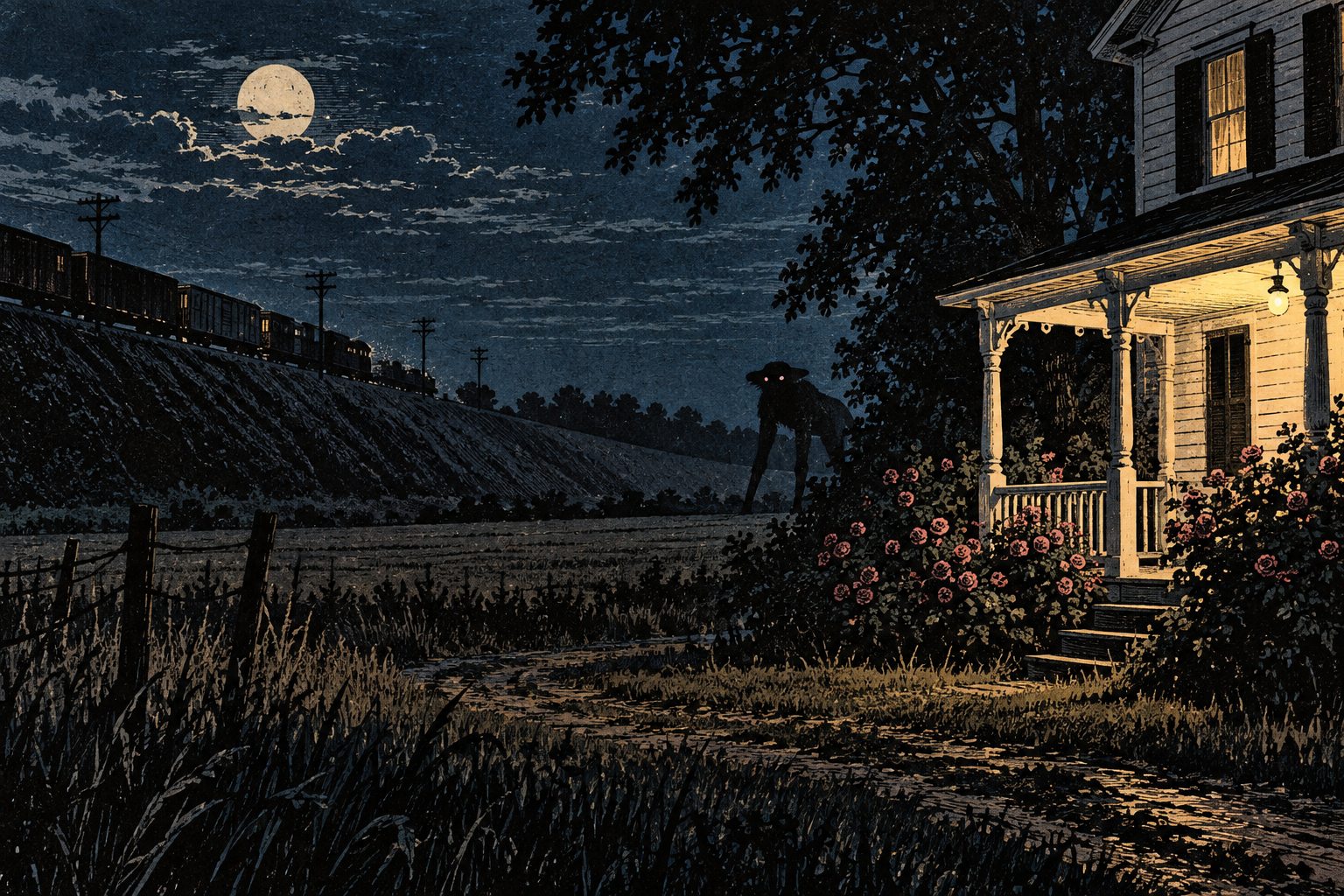
Editorial illustration, not documentary imagery.
In April 1973, a man in rural Illinois reported shooting an unidentified creature outside his home. He described a gray, three-legged animal with short arms and enormous pink eyes. Police reportedly found unusual six-toed tracks, and additional sightings brought reporters, armed monster hunters, and paranormal investigators to the area. Five years later, sociologists published a study that challenged the popular explanation of mass hysteria.
Something Was Scratching at the Front Door
On the night of April 25, 1973, Henry McDaniel returned to his home in Enfield, Illinois, a small town in White County with approximately 750 residents.
His children had been frightened by unexplained scratching noises around the house.
According to later reconstructions, the sounds had moved from the back door to the front, as though an animal was attempting to find a way inside.
McDaniel initially dismissed his children's concerns.
Then he heard the scratching himself.
Believing that a wild animal might be outside, he retrieved a flashlight and a .22-caliber pistol.
When he opened the front door, he saw something standing approximately 12 feet away.
What he described over the following days would become one of the most unusual creature reports in American folklore.
The animal appeared to be between four and a half and five feet tall.
It had a short, grayish body, two unusually small arms emerging from its chest, and enormous pink eyes.
Most remarkably, McDaniel insisted that it had three legs.
He later described the eyes as being as large as flashlights.
The creature was positioned between rose bushes outside the house.
McDaniel believed it had been attempting to enter his home.
He fired four shots.
According to his account, the first bullet struck the creature.
It responded with a hissing sound resembling a wildcat, then leaped away toward the nearby railroad embankment.
McDaniel claimed it covered approximately 50 feet in three jumps.
Other accounts published afterward increased that distance to approximately 75 feet.
There was no recovered animal or independently verified gunshot injury.
Nevertheless, McDaniel contacted the police.
Police Reportedly Discover Six-Toed Footprints
Illinois State Police officers responded to the property and examined the area.
One of the responding officers was Trooper James Masser.
According to contemporary reports, Masser found McDaniel rational and sober when discussing the incident.
Investigators reportedly discovered unusual impressions in the soft ground outside the house.
The tracks resembled those of a dog, but there was a significant difference.
They appeared to have six toe pads.
Some impressions were approximately four inches across, while another was slightly smaller.
According to later reporting, plaster casts were made of the tracks.
Investigators also reportedly observed damage to a screen door, scratches in the wood, and a slimy substance around the entrance.
Later accounts mentioned unidentified fur caught on nearby rose bushes.
These details became central to claims that the sighting involved something more substantial than a mistaken observation.
However, the original casts, alleged fur samples, and other possible physical evidence are not available for independent scientific examination today.
No verified laboratory identification established that the tracks belonged to an unknown animal.
The six-toed impressions might have resulted from overlapping animal tracks, an unusual paw, inaccurate interpretation, or deliberate fabrication.
Their exact origin has never been established.
A Ten-Year-Old Boy Claims the Monster Attacked Him
The story became more complicated when investigators heard about another alleged encounter.
A local boy named Greg Garrett, approximately ten years old, reportedly claimed that a creature had approached him while he was playing outside.
According to the early version of his story, the animal stepped on his feet and tore his tennis shoes.
The encounter supposedly occurred shortly before McDaniel reported seeing the creature.
That account appeared to suggest that something unusual had been moving through the neighborhood before McDaniel opened his door.
However, years later, sociologists investigating the incident interviewed Garrett and his mother.
They discovered that the boy's story had been a prank.
The damaged shoe he associated with the monster had not been destroyed by an unidentified animal.
The researchers concluded that Garrett and his family had been entertaining themselves at the expense of visiting reporters.
The admission significantly weakened what had initially appeared to be a corroborating encounter.
It also demonstrated how easily a sensational story could acquire additional eyewitness testimony once media attention arrived.
The Monster Returns Near the Railroad Tracks
McDaniel did not withdraw his original story.
On May 6, 1973, approximately 11 days after his first encounter, he reported seeing the creature again.
The second incident occurred around 3 a.m.
Neighborhood dogs were reportedly barking and howling.
McDaniel looked outside and noticed something moving along the railroad tracks near his home.
He believed it was the same three-legged creature.
This time, however, the animal did not approach the house.
McDaniel described it moving along the railroad embankment without appearing particularly hurried.
He did not fire his weapon.
Instead, the account reached WWKI, a radio station based in Kokomo, Indiana.
The station's news director, Rick Rainbow, became interested in the story and traveled to the area with several companions.
Rainbow subsequently claimed that his group observed a strange animal near an abandoned building close to McDaniel's property.
The witnesses described a grayish creature approximately five feet tall, moving in a hunched position.
Their observation was brief, and they did not get a clear view of its face.
Rainbow also reported recording an unusual cry that he believed came from the animal.
The recording became part of the growing monster story.
However, the original audio has not survived in a form available for independent verification.
Armed Monster Hunters Arrive in Enfield
As the Enfield story spread through newspapers and radio broadcasts, visitors began arriving in the community.
Some were journalists.
Others were curious members of the public.
A smaller number came equipped with weapons, apparently hoping to capture or kill the mysterious creature.
The sudden attention frustrated local law enforcement.
White County Sheriff Roy Poshard Jr. was particularly skeptical of the claims.
He expressed concern that armed visitors searching through fields and wooded areas might accidentally shoot residents or livestock.
The situation escalated when deputies received reports of gunfire.
On May 8, five young men from outside the community were arrested following an incident involving firearms.
They claimed to have encountered something unusual in the brush.
Some reportedly believed they had shot at a gray, hairy creature.
But officers found no captured animal.
The young men faced hunting-related violations.
Sheriff Poshard later downplayed the suggestion that their activities represented a serious scientific expedition.
The larger concern was that rumors about a monster were drawing armed strangers into a rural community.
The story had progressed from an alleged animal encounter to an actual public-safety problem.
Cryptozoologists Investigate the Strange Reports
The Enfield incident also attracted the attention of investigators interested in unidentified animals.
Among them was Loren Coleman, who later became widely associated with cryptozoology.
Coleman visited southern Illinois to investigate the creature reports and interviewed people associated with the sightings.
Another investigator, Richard Crowe, participated in related investigations.
Neither man documented seeing the three-legged creature.
However, they reported hearing an unusual, high-pitched cry while searching the area.
In July 1974, Coleman and writer Jerome Clark published an article titled Swamp Slobs Invade Illinois in FATE magazine.
The article examined the Enfield reports alongside other alleged monster encounters in Illinois.
It preserved McDaniel's description, the unusual footprints, the second railroad sighting, and claims involving additional witnesses.
The investigation also linked the Enfield events to a broader series of strange animal reports that had emerged around southern Illinois in 1973.
Those reports included sightings of large, hairy, humanlike creatures around Murphysboro and other communities.
However, the descriptions varied significantly.
The Enfield creature was relatively short and allegedly had three legs.
The Murphysboro reports generally described much larger, two-legged, ape-like animals.
There was no physical evidence establishing that the incidents involved the same species or even related phenomena.
The apparent connection largely came from geography, timing, and the fact that each story involved an unidentified creature.
Was the Monster an Escaped Kangaroo?
One explanation appeared almost immediately.
Perhaps McDaniel had encountered a kangaroo.
Kangaroos stand on two powerful hind legs and possess a thick, muscular tail.
When standing still or moving slowly, the tail can function as a supporting limb.
In darkness, an unfamiliar observer might interpret the resulting posture as three-legged.
Their ability to leap considerable distances also resembles McDaniel's account of the creature escaping in a series of enormous jumps.
The hypothesis gained further attention when a man from Ohio reportedly contacted authorities in May 1973 about a missing pet kangaroo.
The animal, reportedly named Macey, had escaped approximately a year earlier.
A reward was offered for its return.
However, there was no evidence connecting that particular kangaroo to the Enfield sighting.
McDaniel also rejected the explanation.
He told reporters that he had encountered kangaroos during his military service in Australia and knew what they looked like.
He insisted that the creature outside his house was something different.
Other suggested explanations included an escaped exotic primate, a large dog, or another ordinary animal misidentified in poor lighting.
None was conclusively demonstrated.
Scientists Arrive to Study the People, Not the Monster
The most consequential investigation came from Western Illinois University.
Sociologists David L. Miller, Kenneth J. Mietus, and Richard A. Mathers traveled to Enfield approximately two weeks after the original reports began circulating.
Their objective was not to prove that the creature existed.
They wanted to study the community's reaction.
At the time, sociologists frequently used the concept of social contagion to explain unusual collective behavior.
Under the traditional model, an extraordinary event could trigger rumors, emotional excitement, and increasing suggestibility.
People might become convinced that they were experiencing the same phenomenon, even when little objective evidence existed.
The researchers initially considered whether Enfield represented this type of mass hysteria.
However, interviews with local residents complicated that explanation.
They found that surprisingly few people claimed to have seen the monster.
Most residents were skeptical.
Some believed McDaniel had encountered an ordinary animal.
Others suggested he had misinterpreted something in the darkness.
Some simply viewed the situation as a strange story that had become a popular topic of conversation.
The researchers also discovered that at least one supposedly important witness account—the story involving Greg Garrett's damaged shoe—had been fabricated.
The case was becoming less a demonstration of an entire community losing its ability to reason and more an example of a limited incident receiving extraordinary attention.
The 1978 Study Challenged the Mass Hysteria Explanation
In January 1978, Miller, Mietus, and Mathers published their findings in The Sociological Quarterly.
The paper was titled A Critical Examination of the Social Contagion Image of Collective Behavior: The Case of the Enfield Monster.
Their argument challenged a common assumption about unusual collective events.
The researchers maintained that reported sightings, public curiosity, and widespread media attention should not automatically be treated as evidence of the same psychological process.
In Enfield, most residents had not reported seeing anything extraordinary.
They had simply heard about the incident.
Some discussed possible explanations.
Others expressed skepticism or amusement.
A small number of outsiders traveled to the town, attracted by media coverage.
The researchers argued that ordinary communication patterns, community institutions, and the availability of people to participate in the event better explained the reaction than a theory of contagious irrationality.
Their conclusion was not that a monster existed, nor that mass hysteria had been proven. It was that the conventional mass-hysteria explanation failed to describe what had actually happened in Enfield.
That distinction is often missing from later retellings.
The sociologists had studied how the story spread, not conducted a zoological investigation that could conclusively identify McDaniel's animal.
PBS Revisits the Case More Than 50 Years Later
On August 11, 2026, PBS released an episode of its folklore series Monstrum titled Why This Monster Sighting Was Different.
The episode revisited the original 1973 sightings and the Western Illinois University investigation.
It included retrospective interviews with researchers familiar with the case.
Kenneth Mietus discussed how the investigators found relatively little evidence of widespread hysteria.
The researchers had expected a community gripped by fear or shared delusions.
Instead, they encountered people who were largely carrying on with ordinary life while talking about an unusual local event.
The television program highlighted the distinction between public attention and genuine collective panic.
The Enfield incident received extensive media coverage because its central claim was extraordinary.
A three-legged monster with enormous pink eyes was an appealing headline.
As newspapers repeated the account, it attracted additional visitors, inquiries, rumors, and attempted investigations.
That publicity helped create the impression of a major monster outbreak.
But the number of documented firsthand sightings remained extremely small.
The case became a useful example of how folklore develops through communication rather than requiring everyone involved to believe the same extraordinary claim.
What Happened to Henry McDaniel?
McDaniel continued defending his account despite widespread skepticism.
He maintained that he had encountered an unusual creature outside his home.
He also speculated that the animal might not have originated on Earth.
The county sheriff reportedly grew increasingly frustrated with McDaniel's public statements and the unwanted attention they brought to Enfield.
Some accounts describe threats of arrest if the reports continued.
Contemporary reporting also shows that many townspeople did not accept the extraordinary explanation.
By the summer of 1973, the immediate frenzy surrounding Enfield had largely faded.
The creature was never captured.
There was no verified carcass, photograph, or biological specimen.
No additional evidence established the existence of an unknown three-legged species in southern Illinois.
The eyewitness claims remained part of local folklore.
Later writers and paranormal researchers continued revisiting the case, gradually establishing the name Enfield Horror as one of the best-known cryptid legends associated with Illinois.
More Than Five Decades Later, What Was the Enfield Horror?
The historical record establishes that McDaniel reported encountering a strange animal in April 1973.
Police investigated.
Unusual tracks were described.
Other people subsequently reported sightings or sounds, and armed visitors traveled to Enfield.
Those events are documented through contemporary news coverage and later investigations.
However, the central claim—that an unidentified three-legged creature existed—has never been verified.
There are several plausible explanations.
McDaniel may have misidentified an ordinary or escaped exotic animal under poor viewing conditions.
The reported footprints may have been misinterpreted.
Additional publicity may have encouraged exaggerated or fabricated stories.
The confirmed prank involving Greg Garrett demonstrates that some participants were willing to exploit the media attention.
None of those possibilities definitively explains McDaniel's original account.
The absence of preserved physical evidence prevents investigators from reaching a reliable biological identification.
What makes the case historically significant is not just the description of the creature.
It is what happened after the alleged sighting.
A brief encounter outside one rural home became a national story.
It attracted armed hunters, radio journalists, paranormal investigators, and university researchers.
It eventually became the subject of a peer-reviewed sociological paper and a PBS documentary more than half a century later.
The Enfield Horror was never proven to be a monster. But the story itself became something real: an enduring piece of American folklore created from a handful of sightings, an enthusiastic news cycle, and a small town that never collectively agreed on what had happened.

Jude Cassian
Jude Cassian tracks the strange, dark, unexplained, and absurd corners of the world with independent curiosity and no political or religious spin.
Sources
Suggested Articles You Might Enjoy
An Eight-Foot Monster Lizard Took Over a Florida Family's Backyard and Evaded Capture for Months
Bamboo, an escaped eight-foot Asian water monitor, spent more than two months loose around homes in Davie, Florida, before wildlife officers captured it.
Mystery Animal Attacks Three People in New Hampshire: Police Fear Rabies as Creature Evades Capture
Three people reported attacks by an unidentified animal near Lebanon, New Hampshire. Police suspected a gray fox or fisher, but rabies was never confirmed.
Rabid Raccoons Return to Los Angeles After 53 Years: Two Test Positive, Six Workers Get Exposure Follow-Up
Two rabies-positive raccoons appeared in Westlake Village within weeks. Six workers were referred for exposure follow-up as officials investigate a bat-linked variant.
Reference
https://www.newspapers.com/newspage/30409597/
Reference
https://doi.org/10.1111/j.1533-8525.1978.tb02176.x
Reference
https://www.coasttocoastam.com/alternate/amp/article/fate-flashback-swamp-slobs-of-illinois-pt2/
Reference
https://video.will.illinois.edu/video/why-this-monster-sighting-was-different-dbqhcd/
Reference
https://fox2now.com/news/true-crime/enfield-monster-illinois-creature-or-mob-mentality/
Reference
https://www.thevillagersvoice.com/the-enfield-horror/
Reference
https://unresolved.me/the-enfield-monster
Reference
https://www.paranormalscholar.com/the-enfield-monster-how-a-bizarre-unidentified-creature-gripped-illinois/
Reference
https://copycateffect.blogspot.com/2014/05/Enfield-McDaniel.html?m=0
Reference
https://astonishinglegends.com/al-podcasts/2022/4/23/ep-232-the-enfield-horror-and-other-midwest-monsters
Reference
https://astonishinglegends.com/al-podcasts/2022/5/15/ep-233-what-it-wasnt-or-how-i-learned-to-stop-dismissing-potentially-paranormal-events-as-mass-hysteria