
An Eight-Foot Monster Lizard Took Over a Florida Family's Backyard and Evaded Capture for Months
Bamboo, an escaped eight-foot Asian water monitor, spent more than two months loose around homes in Davie, Florida, before wildlife officers captured it.
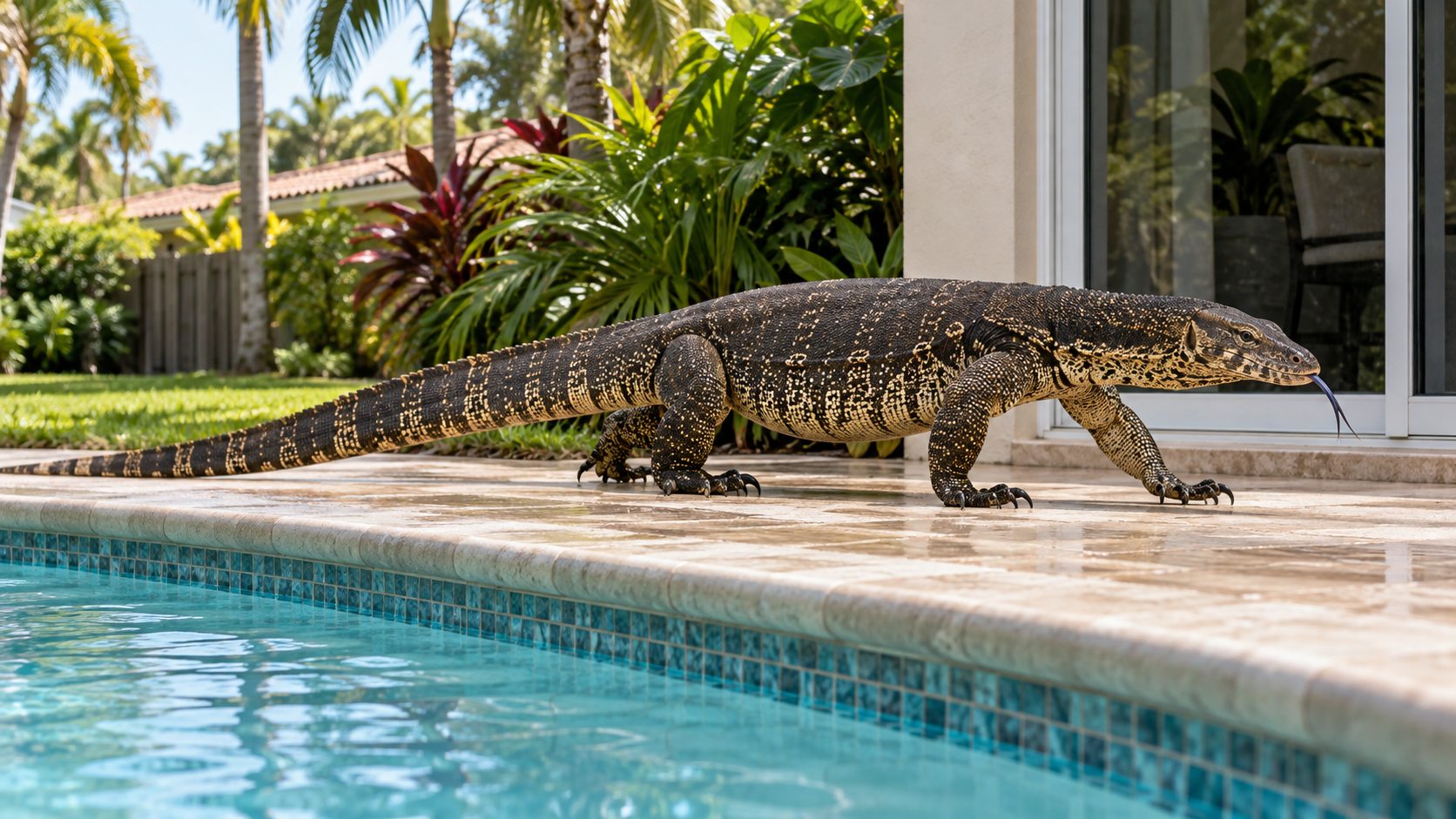
Editorial illustration, not documentary imagery.
In August 2018, a Florida family discovered an enormous reptile roaming around their swimming pool and scratching at their patio door. The animal, eventually identified as an Asian water monitor named Bamboo, repeatedly escaped professional trappers and wildlife officers. For more than two months, residents worried about letting their children and pets outside. The investigation eventually revealed that the giant lizard was an escaped pet.
A Dinosaur Appears Outside a Florida Home
In late August 2018, Zachary and Maria Lieberman were at their home in Davie, Florida, when Maria noticed something enormous moving around the backyard.
The animal was walking along the patio near the family's swimming pool.
At first, she thought it was an alligator.
But when the creature moved closer, she noticed its long, forked tongue and unusually large, muscular body.
It was a giant monitor lizard.
The family had recently watched Jurassic Park with their two young children, making the sudden appearance even more unsettling.
Maria began recording the animal with her cellphone as it wandered across the patio.
The lizard approached the sliding glass door and appeared to investigate the inside of the house.
According to contemporary reporting, it also scratched at the door.
The Liebermans had two children, ages two and four, who regularly played in the backyard and used the swimming pool.
The parents became concerned about allowing them outside.
The creature was approximately the length of an adult human, possibly longer, and had sharp claws, powerful jaws, and a muscular tail.
And unlike an alligator, it was capable of climbing trees.
The Lizard Refuses to Leave
Zachary Lieberman initially attempted to scare the animal away.
It did not respond as he expected.
Instead of retreating immediately, the reptile reportedly moved toward him and followed him around the house.
Lieberman later described the encounter to local television reporters.
He was particularly worried about how quickly the animal could move if one of his children encountered it.
The lizard eventually retreated toward nearby wooded areas.
But it repeatedly returned.
Neighbors spotted it around a lake, sunbathing in yards and moving through vegetation.
The Liebermans began avoiding their own backyard.
Their swimming pool, which had been a normal part of family life, was effectively off-limits.
The lizard was not documented attacking anyone, but its size and unpredictable movements were enough to frighten residents.
The family contacted the Florida Fish and Wildlife Conservation Commission (FWC).
Professional trappers soon joined the search.
Even Professional Trappers Couldn't Catch It
One of the people involved was Mike Kimmel, known as "Trapper Mike," of Martin County Trapping & Removals.
Kimmel had experience capturing dangerous and difficult reptiles, including large snakes.
However, the monitor lizard proved challenging.
Wildlife officers and trappers tried several approaches.
They placed traps containing dead rodents and chicken meat around locations where the lizard had been seen.
They used hunting dogs to follow its scent.
At one point, officers deployed a video camera scope into a suspected burrow to check whether the reptile was hiding inside.
The attempts were unsuccessful.
Whenever the animal appeared close to being captured, it escaped into vegetation or other inaccessible areas.
The wooded landscape around the Liebermans' neighborhood provided numerous places to hide.
The reptile was also capable of swimming, making nearby waterways another potential escape route.
As the story spread nationally, the animal acquired an increasingly dramatic reputation.
Some news outlets described it as a monster.
Others compared it to a dinosaur.
The reptile, meanwhile, continued avoiding capture.
The Giant Lizard Had a Name: Bamboo
Investigators eventually discovered that the animal was not a wild reptile that had somehow naturally established itself in the neighborhood.
It was an escaped pet.
Its name was Bamboo.
During the first days of reporting, several outlets described the animal as a Nile monitor, a large African lizard species already known to have established populations in parts of Florida.
Others identified it as an Asian water monitor.
The distinction was resolved by the Florida Fish and Wildlife Conservation Commission.
Bamboo was an Asian water monitor, Varanus salvator, a species native to South and Southeast Asia.
These lizards are among the largest living reptiles.
They are powerful swimmers, capable climbers, and opportunistic carnivores that feed on fish, rodents, birds, eggs, and other animals.
Bamboo was unusually large even by the standards of many captive monitor lizards.
Early reports estimated the animal's length at approximately six or seven feet and its weight at 100 to 150 pounds.
However, the official measurement after capture established that it was more than eight feet long.
The lizard had not simply wandered into someone's garden.
It was a very large exotic pet that had escaped confinement and moved through a residential community for weeks.
Could Bamboo Have Attacked a Child?
The Liebermans' greatest concern was the safety of their children.
Large monitor lizards possess sharp teeth, strong jaws, long claws, and muscular tails.
An animal of Bamboo's size could inflict serious injuries if frightened, cornered, or handled improperly.
However, there is a difference between an animal being physically capable of injuring someone and deliberately hunting people.
Ron Magill of Zoo Miami explained during the original coverage that Asian water monitors do not ordinarily seek out humans as prey.
They may nevertheless bite or scratch when cornered or threatened.
Small pets could also be at risk because monitor lizards are opportunistic predators.
The family expressed fears that Bamboo might attack a child or catch a small animal.
But the available reports do not establish that Bamboo injured any resident, killed a pet, or attempted to prey on a person.
Lieberman speculated that the animal might have eaten a neighborhood raccoon, but that suspicion was never independently confirmed.
The danger came from having a powerful, unfamiliar reptile loose in an area where children and pets regularly played.
The Search Continues Into November
As September passed, Bamboo remained elusive.
Wildlife officers continued monitoring possible sightings and communicating with residents.
The lizard's owner also began cooperating with investigators.
According to the FWC, the owner provided information about Bamboo's behavior that helped officers understand where and when the reptile was likely to appear.
For more than two months, the animal continued moving through the Davie area.
The situation finally changed on November 5, 2018.
A local homeowner called the FWC's Exotic Species Hotline.
He reported repeatedly seeing a large monitor lizard on his property around midday.
This was precisely the type of information officers needed.
Instead of searching an extensive wooded area without knowing where the animal might appear, they now had a location and an approximate time.
Biologists prepared to respond.
November 6: Bamboo Is Finally Captured
Shortly before noon on November 6, 2018, FWC biologists arrived at the property identified in the previous day's report.
This time, the operation succeeded.
Officers captured Bamboo without any publicly reported injuries.
The agency formally announced the capture on November 8.
Its statement confirmed that the animal was an Asian water monitor measuring more than eight feet long.
The successful operation brought an end to a search that had lasted since late August.
Zachary Lieberman expressed relief.
For weeks, the family and nearby residents had been reluctant to allow children and pets to spend time outside.
With Bamboo finally secured, the Liebermans could return to using their backyard and swimming pool without worrying about another encounter.
The unusual incident had come to an end without a reported attack.
The Owner Receives a Criminal Citation
The investigation did not end with the capture.
Wildlife officials identified Bamboo's owner and issued a criminal citation for allowing the exotic animal to escape.
At the time, Florida did not require a special permit to possess an Asian water monitor as a personal pet.
However, owners were required to provide suitable enclosures that prevented animals from escaping.
The FWC cited the owner under Rule 68A-6.0023 of the Florida Administrative Code.
Officers also inspected the enclosure to assess whether it met the applicable containment requirements.
The agency announced that Bamboo would be returned to its owner.
Some contemporary media reports suggested the reptile might instead be relocated to a zoo.
However, the FWC's official November 8 statement identified return to the owner as the intended disposition.
The available official announcement does not independently document a subsequent transfer to a zoo.
Nor does the citation establish that the owner was convicted of a criminal offense.
Florida's Exotic Pet Problem
Bamboo's escape highlighted a broader challenge involving exotic wildlife in Florida.
The state's warm climate can allow nonnative reptiles to survive outside captivity for extended periods.
Some species have established breeding populations after being released or escaping from private collections.
The Burmese python is among the best-known examples.
Nile monitors have also become established in parts of Florida, particularly around Cape Coral.
These animals can threaten native wildlife through predation and competition.
Asian water monitors are not native to Florida either.
However, the discovery of a single escaped Asian water monitor does not establish that the species has formed a breeding population in the area.
Bamboo's case was specifically documented as an escaped captive animal.
The FWC operates an Exotic Pet Amnesty Program that allows owners to surrender unwanted exotic pets without penalties for the surrender itself.
The objective is to prevent animals from being released into the environment when owners can no longer care for them.
State rules have also changed since 2018.
In April 2021, Florida added Nile monitors and several other high-risk reptiles to its prohibited-species list.
Those later restrictions should not be confused with the rules governing Bamboo, which was a different species.
A Backyard Encounter That Became International News
The original encounter received coverage from ABC News, CBS, The Washington Post, The Miami Herald, The Daily Beast, and numerous international outlets.
A video of the enormous lizard moving across the Liebermans' patio helped explain the attention.
Bamboo did not resemble the small lizards commonly seen on Florida fences and garden walls.
Its body was massive, its tongue flicked continuously, and its movements appeared deliberate as it investigated the backyard.
The fact that professional trappers repeatedly failed to capture it added to the story.
What began as a strange backyard sighting developed into a wildlife search involving residents, police, animal-control specialists, and state biologists.
The animal became a local celebrity before anyone could catch it.
What Happened to the Monster Lizard?
The final outcome was less dramatic than the original headlines suggested.
Bamboo was not an unknown prehistoric creature, a newly discovered species, or a wild predator deliberately targeting a family.
It was an escaped Asian water monitor that had learned to move through a landscape of residential yards, lakes, and wooded areas while avoiding capture.
After weeks of unsuccessful attempts, a resident's tip gave wildlife officers the information needed to secure the animal.
The owner received a criminal citation, and the family reclaimed its backyard.
No confirmed injuries to humans or pets were attributed to Bamboo during the incident.
The most unusual part of the story is that an eight-foot exotic reptile was able to remain loose in a densely populated Florida neighborhood for more than two months while repeatedly evading people specifically trained to capture large animals.
For the Lieberman family, what first looked like something from Jurassic Park turned out to be somebody else's escaped pet.

Jude Cassian
Jude Cassian tracks the strange, dark, unexplained, and absurd corners of the world with independent curiosity and no political or religious spin.
Sources
Suggested Articles You Might Enjoy
The Enfield Horror: A Three-Legged Monster, Six-Toed Footprints, and the Illinois Town That Became a Cryptid Mystery
In 1973, an Illinois man reported a three-legged creature outside his home. A later sociological study examined how the Enfield Horror became an enduring cryptid legend.
Mystery Animal Attacks Three People in New Hampshire: Police Fear Rabies as Creature Evades Capture
Three people reported attacks by an unidentified animal near Lebanon, New Hampshire. Police suspected a gray fox or fisher, but rabies was never confirmed.
Rabid Raccoons Return to Los Angeles After 53 Years: Two Test Positive, Six Workers Get Exposure Follow-Up
Two rabies-positive raccoons appeared in Westlake Village within weeks. Six workers were referred for exposure follow-up as officials investigate a bat-linked variant.
Reference
https://www.nydailynews.com/2018/09/04/scary-looking-6-foot-long-lizard-terrorizing-florida-family/
Reference
https://content.govdelivery.com/accounts/FLFFWCC/bulletins/21a272e
Reference
https://abcnews.com/US/giant-lizard-terrorizes-florida-family-moving-backyard/story?id=57499299
Reference
https://wsvn.com/news/local/trapper-determined-to-capture-nile-monitor-in-davie-neighborhood/
Reference
https://www.washingtonpost.com/science/2018/08/31/florida-family-terrorized-by-backyard-squatter-giant-lizard-that-looks-like-something-out-jurassic-park/
Reference
https://www.thedailybeast.com/a-six-foot-lizard-is-terrorizing-a-florida-family-trappers-cant-catch-him/
Reference
https://www.cbsnews.com/miami/news/giant-monitor-lizard-davie/
Reference
https://www.miamiherald.com/news/local/community/broward/article221343990.html
Reference
https://reptilesmagazine.com/escaped-asian-water-monitor-captured-after-3-months-on-the-lam/
Reference
https://myfwc.com/wildlifehabitats/nonnatives/exotic-information/
Reference
https://myfwc.com/wildlifehabitats/nonnatives/dont-let-it-loose/
Reference
https://myfwc.com/wildlifehabitats/profiles/reptiles/lizards/nile-monitor/