
The House Next Door Became a Drug Den: How an Arizona Neighborhood Fought Back Against Squatters
Mesa neighbors petitioned city leaders over a vacant house and suspected drug activity. A July 2026 police search led to an arrest, but the property remains unresolved.
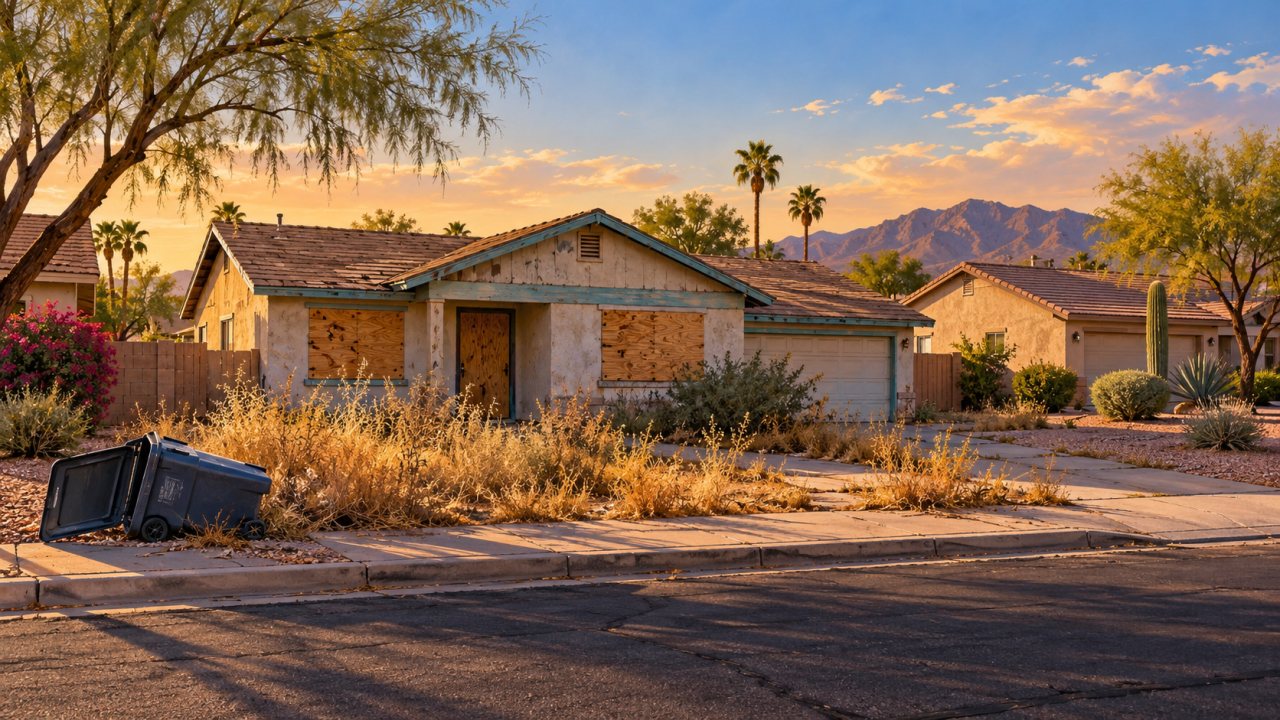
Editorial illustration, not documentary imagery.
For nearly two years, residents of a Mesa, Arizona, neighborhood watched an abandoned house deteriorate into a suspected drug property. Strangers came and went at all hours, foul odors spread to surrounding homes, and drug paraphernalia appeared nearby. Repeated complaints initially brought little relief. Then neighbors organized, pressured city officials, and watched a SWAT team raid the property.
An Empty House Becomes a Neighborhood Problem
For years, residents of Matlock Street in Mesa, Arizona, lived in a relatively ordinary residential neighborhood near Main Street and Mesa Drive.
That began to change around 2024, when the owners of one house were arrested.
According to reporting by 12News, the property remained vacant for approximately two months before squatters began occupying it.
Neighbors initially noticed people coming and going. Before long, the house appeared to be attracting an increasing number of visitors, including people arriving at unusual hours.
Dan Shumway, a father of four who lived next door, watched the situation deteriorate.
The people entering the house were unfamiliar to him, and the activity continued throughout the day and night.
Residents described persistent noise, suspicious traffic, garbage, and strong odors coming from the property.
The house had become a source of constant frustration.
What concerned the neighbors most was not simply that unauthorized people were living inside an empty building. They suspected illegal drug activity was taking place there.
Strange Smells and Drug Paraphernalia
By 2026, residents were reporting conditions they believed posed serious safety concerns.
Crystal Price, another neighborhood resident, described repeated visits to the property and drug-related materials appearing nearby.
Speaking to ABC15, Price said, "You can tell there's been drug use."
Shumway reported unusual smells drifting from the neighboring house.
He could not identify the substance responsible, but the odors were unlike anything he associated with ordinary household activities.
Residents worried that chemicals, drugs, or burning materials might be involved.
Those concerns were understandable, although the odors alone did not establish that methamphetamine was being manufactured inside the property.
No publicly verified report established that the house contained an operational methamphetamine laboratory.
The suspected drug activity was nevertheless sufficient to concern residents living directly beside the building.
For Shumway, the situation was particularly troubling because he was raising four children next door.
Why the Police Could Not Immediately Remove Everyone
Residents contacted authorities about the house, but the complaints did not initially result in a permanent solution.
According to ABC15, police had limited options during the early stages of the situation.
The distinction between trespassing, squatting, and criminal drug activity can complicate enforcement.
An abandoned-looking property is not necessarily ownerless. A homeowner's absence, incarceration, or failure to maintain a building does not automatically give the city unrestricted authority to enter it or remove everyone inside.
Police must have an appropriate legal basis to arrest occupants or search a residence.
Even when neighbors report suspicious behavior, officers generally need sufficient evidence of a specific crime to take further enforcement action.
There is also a distinction between the presence of unauthorized occupants and a property being used to distribute illegal drugs.
The available reporting does not establish every police call, investigative step, or legal obstacle encountered in the Mesa case.
What is clear is that residents believed the problem had continued far too long.
They decided that individual complaints were not producing the response they needed.
Neighbors Organize a Petition
Crystal Price and other residents began organizing the neighborhood.
Rather than relying solely on separate police complaints, they collected signatures for a petition and brought the matter directly to city officials.
In early June 2026, residents presented their concerns to the Mesa City Council.
Their complaints focused on the continuing occupation of the vacant property, suspected drug activity, odors, and the effect on neighborhood safety.
The residents also continued monitoring what was happening around the building.
Their efforts created a more organized record of neighborhood concerns.
A petition does not establish that a crime has occurred, and a City Council appearance cannot replace the evidence needed for a criminal search warrant.
However, the public effort brought additional attention to a situation that neighbors said had been disrupting their lives for nearly two years.
Less than a month later, police carried out a major operation.
July 2, 2026: SWAT Arrives at the Property
On July 2, 2026, Mesa police officers arrived at the Matlock Street house with a SWAT team.
They had obtained a search warrant.
Officers entered the property and arrested 54-year-old Jason May.
According to ABC15's reporting, investigators said May admitted possessing several grams of methamphetamine inside the residence.
He faced three felony charges connected to the investigation.
The police operation provided confirmation that the property contained alleged criminal drug activity, although it did not establish every allegation residents had made during the preceding months.
The precise nature of all three charges was not detailed in the publicly accessible reporting reviewed for this article.
Nor does an arrest establish guilt. The charges remained allegations unless resolved through a guilty plea or criminal conviction.
The operation was nevertheless the most significant enforcement action neighbors had seen.
Police Board Up the House
After the search and arrest, authorities secured the property.
Doors and windows were boarded up to discourage anyone else from entering and occupying the building.
For residents who had watched the property deteriorate, the barricaded entrances represented a significant change.
The house that had attracted frequent visitors was no longer freely accessible.
The immediate problem appeared to have been brought under control.
However, the property itself remained.
The building was still standing, and the neighborhood had no guarantee that it would be rehabilitated or permanently secured.
Some residents wanted it demolished.
Others hoped the house could be repaired and returned to legitimate residential use.
Price expressed surprise that their relatively modest organizing efforts had helped bring attention to the situation.
The residents' petition, City Council appearance, and continued complaints preceded the raid, although the available records do not establish precisely how those efforts influenced the timing of the search warrant.
Should the House Be Demolished?
Following the arrest, neighbors began discussing the future of the property.
One resident told ABC15 that the building was in such poor condition that it should be torn down.
Demolition, however, is not automatic simply because squatters occupied a residence or police found drugs inside it.
A municipality generally needs to evaluate the building's condition and follow applicable nuisance, building-code, and property enforcement procedures.
The city may have several options depending on the circumstances, including requiring repairs, securing the building, enforcing maintenance regulations, or pursuing demolition if legally justified.
Mesa's Code Compliance division handles complaints concerning unsecured properties, unsafe structures, fire hazards, and other neighborhood maintenance problems.
The city's published procedures explain that some complaints may be referred to building inspectors or other departments depending on the nature of the hazard.
As of the reporting available through October 25, 2026, there was no independently confirmed announcement establishing that the Matlock Street house had been demolished.
Its eventual rehabilitation, sale, or demolition remained unresolved in the reports examined.
The Problem With Abandoned Homes
The Mesa incident illustrates a broader problem affecting neighborhoods with vacant and poorly maintained properties.
An empty house can become vulnerable when nobody is regularly maintaining it, inspecting it, or securing its entrances.
Unauthorized occupants may begin using the property, making it difficult for neighbors to determine who has a legitimate right to be there.
If suspected criminal activity develops, the situation becomes more complicated.
Residents may observe frequent visitors, unusual odors, property damage, or discarded materials without having direct evidence of the crimes they suspect.
Even when a building's condition violates municipal codes, property enforcement and criminal investigations operate under different legal procedures.
The City of Mesa recognizes that certain patterns of activity can justify closer examination.
Its official police guidance identifies unusual vehicle traffic, irregular occupancy, poor maintenance, and other suspicious behavior as possible indicators of drug-related activity.
The department also cautions that none of these indicators, standing alone, proves a property is being used for illegal activity.
Residents are encouraged to report specific observations rather than confront suspected offenders themselves.
What Happened to Jason May?
The July 10 reports from 12News and ABC15 identified Jason May as the person arrested during the July 2 police operation.
ABC15 reported that he faced three felony charges and had allegedly acknowledged possessing methamphetamine.
However, searches of subsequent public reporting did not establish a final court judgment, plea agreement, or sentence in connection with the Matlock Street investigation.
No verified source reviewed for this article established that May was convicted or that the property was permanently closed through a final court order.
The distinction matters because the July arrest and the neighbors' account document the investigation's immediate outcome, not necessarily the final disposition of the criminal case.
The original property owners' arrests around 2024 were also reported without sufficient information to establish their identities, charges, or relationship to the later suspected drug activity.
Those separate events should not be treated as part of one proven criminal conspiracy.
Nearly Two Years of Complaints Before a Resolution
The Matlock Street case attracted attention because residents described living beside a problem property for approximately two years before the July 2026 raid.
A building that had once been an ordinary home became a persistent neighborhood concern.
Residents reported suspicious visitors, alleged drug activity, strong odors, and deteriorating conditions.
They eventually organized a petition and addressed the Mesa City Council.
On July 2, officers executed a search warrant, arrested a suspect, and boarded up the building.
The raid addressed the immediate occupancy problem, but it left the neighborhood with another question: what should happen to the property afterward?
For Crystal Price, Dan Shumway, and other residents, a long-term solution would mean more than an arrest.
It would mean restoring the building to legitimate use or ensuring that it could no longer attract the same problems.
The most disturbing feature of the case was how an apparently ordinary vacant home became a source of neighborhood anxiety for almost two years, while the people living beside it struggled to get the situation resolved.

Jude Cassian
Jude Cassian tracks the strange, dark, unexplained, and absurd corners of the world with independent curiosity and no political or religious spin.
Sources
Suggested Articles You Might Enjoy
The Driveway Demolition: A Neighbor Dispute Escalates Into Harassment and Disturbing Signs
A reported driveway and easement dispute escalated into alleged harassment, damaged cameras, disturbing signs, and court action. The outcome remains unknown.
The Armed Squatter: How a Neighbor Terrorized an Oakland Family Before Murdering the Husband
An Oakland family reported escalating harassment by a neighbor before Miles Armstead was killed. The criminal appeal and civil settlement trace what happened.
The Devil House of Bolivia: A Home Covered in Demons Terrifies Neighbors, but Its Owner Says They Protect Him
David Choque covered his El Alto home with horned sculptures tied to Andean mining traditions. Neighbors feared occult activity, but the allegations were never substantiated.
Reference
https://www.12news.com/article/news/local/valley/nightmare-of-drugs-and-crime-how-a-mesa-arizona-home-plagued-a-neighborhood-for-years/75-343f2fc5-5308-4bc0-83ea-2b89d42d7afb
Reference
https://www.abc15.com/news/region-southeast-valley/mesa/mesa-neighbors-take-action-against-suspected-drug-house-leading-to-police-arrest
Reference
https://www.youtube.com/watch?v=D2uvbcggIT0
Reference
https://www.mesaaz.gov/Public-Safety/Mesa-Police/Community/Drugs-in-Neighborhoods
Reference
https://www.mesaaz.gov/Resident-Resources/Code-Compliance
Reference
https://www.mesaaz.gov/Resident-Resources/Code-Compliance/Report-a-Code-Violation
Reference
https://www.mesaaz.gov/Public-Safety/Mesa-Police/Services/Report-a-Non-Emergency-Crime-Online