
The Driveway Demolition: A Neighbor Dispute Escalates Into Harassment and Disturbing Signs
A reported driveway and easement dispute escalated into alleged harassment, damaged cameras, disturbing signs, and court action. The outcome remains unknown.
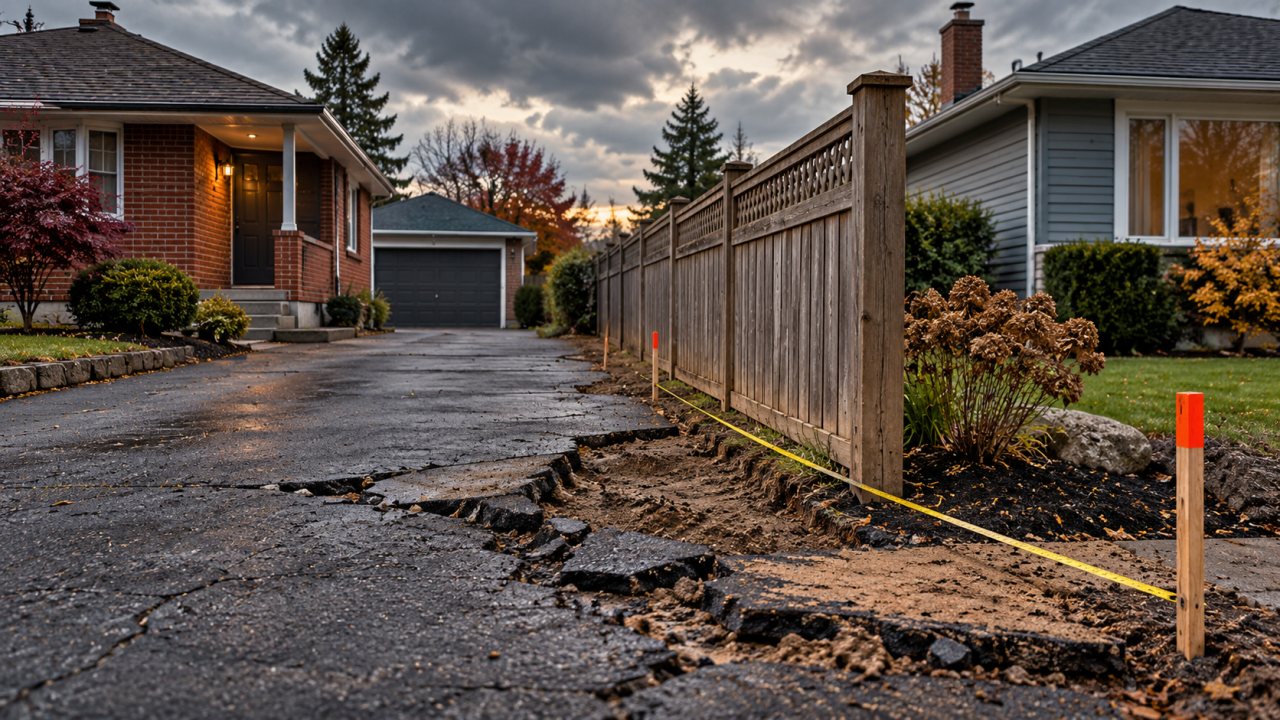
Editorial illustration, not documentary imagery.
What began as a disagreement over a driveway and property boundaries turned into months of alleged harassment, damaged security equipment, repeated police visits, and signs encouraging a neighboring family to take their own lives. The homeowners eventually sought court protection from the man living next door.
The case-specific allegations below come from Devereaux's account of her friends' experience. The people, property records, and court proceedings have not been independently identified.
A New Neighbor Starts Digging Up the Driveway
In September 2022, radio personality Julie Devereaux published an account of a disturbing neighborhood conflict involving a longtime friend and her husband.
The couple had purchased their first home in a quiet neighborhood in an unnamed small town.
Approximately a year after they moved in, another couple purchased the house situated in front of theirs. Their driveway passed alongside the new neighbors' property.
Initially, there was no indication that the arrangement would create a serious problem.
Then the new neighbor began digging up a section of the asphalt driveway.
When the homeowners approached him, he explained that he intended to construct a fence.
They believed he was digging on land that belonged to them or was subject to their access rights. Rather than immediately escalating the disagreement, they asked him to stop until a professional property survey established the relevant boundaries.
The husband even offered to help construct the fence once the survey was completed.
According to Devereaux, the neighbor temporarily stopped digging but resumed the work approximately a week later.
The homeowners soon contacted police.
A Dispute Over Ownership and an Easement
The neighbor reportedly told responding officers that the asphalt was located on his property and that he intended to remove it.
He also proposed charging the homeowners for the removal.
The homeowners disputed his claim, pointing to an easement associated with their driveway.
An easement is a legal right allowing someone to use another person's land for a specific purpose, such as accessing a residence through a driveway.
The underlying ownership and the right to use the land are separate legal questions.
A property owner may possess the land beneath a driveway while another owner has a legally enforceable right to travel across it. The exact scope of that right depends on deeds, surveys, recorded agreements, and applicable law.
In this case, the homeowners maintained that the neighbor had no right to destroy the asphalt.
The dispute was no longer simply about where a fence should stand. It now involved physical interference with an access route used by another household.
According to Devereaux's account, police became involved, but their visits did not resolve the conflict.
The published account does not include the deed, easement document, or survey, so it does not establish the exact boundary or the scope of either household's rights.
The homeowners arranged a property survey, hoping a professional determination would clarify their rights.
But the dispute soon moved beyond land ownership.
The Neighbor Begins Recording the Homeowners
Devereaux reported that the neighbor began repeatedly recording the couple with his cellphone.
His conduct also became verbally abusive.
During one confrontation, he allegedly directed a misogynistic insult at the wife.
The homeowners again contacted police.
According to the published account, officers recommended installing security cameras and seeking a restraining order.
The couple followed both recommendations.
They installed cameras around their property to document further incidents and obtained a protective order against the neighbor.
The order was intended to provide legal protection from harassment.
However, being served with the court paperwork did not bring the confrontation to an end.
Instead, a disturbing message appeared facing their home.
The Sign Telling the Homeowners to Kill Themselves
According to Devereaux, the neighbor erected a sign carrying the words "kill yourself."
It was positioned to face the couple's residence.
The message was not connected to the original boundary question or any legitimate discussion about the driveway.
It was apparently intended to confront the homeowners whenever they looked outside.
After being served with the protective order, the neighbor reportedly modified the sign by adding the word "please."
Devereaux did not establish whether the alteration was an attempt to avoid violating the order, and the text of the order was not made public.
Adding a polite word would not, by itself, determine whether a communication violated a protective order. That would depend on its actual terms, the circumstances, and applicable law.
The neighbor also reportedly erected another sign accusing the woman of being a "Karen."
What began as a dispute over asphalt had developed into a campaign of alleged intimidation directed at the couple's home.
A Security Camera Is Removed and Damaged
One of the more unusual incidents allegedly occurred while the homeowners were away.
After returning home, the husband checked footage from their security cameras.
He discovered that the neighbor had entered their property and approached one of the cameras.
According to Devereaux's description of the recording, the man removed the camera from its mounting pole and carried it around the property while speaking into it.
At one point, he said, "There. Fixed it."
The equipment was damaged and had to be replaced.
The alleged incident was significant because the cameras had been installed following the police recommendation that the homeowners document further harassment.
The neighbor was now accused of interfering with the very equipment intended to record his activities.
The couple continued preserving video, photographs, and audio recordings of incidents around their property.
A Grim Reaper and Pentagram Appear
The signs were not the only unusual displays allegedly directed toward the couple.
Devereaux wrote that the neighbor also placed a Grim Reaper figure and a pentagram on his property, facing the homeowners' residence.
Those objects are not inherently threatening or unlawful. Their significance in this account comes from the surrounding allegations of repeated harassment and the suicide-related signs.
Devereaux interpreted the display as another effort to intimidate her friends.
There is no independently available evidence establishing the neighbor's personal beliefs or why he chose those particular symbols.
The physical displays nevertheless added another element to a dispute already involving confrontations, damaged property, and legal proceedings.
A Property Survey Fails to End the Conflict
By the time Devereaux published her account, the homeowners had received the results of their property survey.
They had also begun constructing their own fence.
Rather than ending the dispute, the fencing project appeared to aggravate the situation further.
Devereaux reported that the neighbor erected another sign encouraging the homeowners to kill themselves.
The couple had already appeared in court for a mediation-related proceeding.
According to the article, a mediator who met separately with the parties recognized that their disagreement extended beyond a conventional boundary dispute.
The homeowners retained an attorney and continued documenting the neighbor's actions.
They also had two additional court appearances scheduled, including one related to harassment.
Devereaux did not provide court case numbers, copies of the orders, or the exact town where the dispute occurred.
Why Police Responses Can Be Complicated
Boundary disagreements often involve both civil and potentially criminal issues.
A dispute over the location of a property line, the interpretation of an easement, or the right to construct a fence generally requires examination of legal documents and sometimes a civil court ruling.
Police officers ordinarily cannot resolve disputed title or easement rights during a routine response.
However, allegations involving deliberate property damage, threats, trespassing, or harassment raise separate questions.
Those matters may warrant investigation regardless of whether the parties also disagree about land ownership.
The outcome depends on the specific conduct, available evidence, and the laws of the jurisdiction.
Restraining orders add another legal consideration.
A protective order may prohibit contact, harassment, approaching a residence, or certain other behavior. Its restrictions depend on what the court actually ordered.
Therefore, an offensive sign does not automatically establish a criminal violation, but neither is it necessarily protected simply because it is displayed on the sign owner's property.
Context and the terms of the order matter.
The Massachusetts court resources linked below are examples of one state's protective-order rules. The original account does not name the town or state, so those rules cannot be assumed to govern this dispute.
In the reported driveway dispute, the couple attempted several measures: police complaints, video surveillance, a survey, legal representation, and court protection.
As of September 2022, those steps had not produced a publicly documented resolution.
What Happened to the Homeowners?
The final outcome remains unclear.
Devereaux's article was published on September 28, 2022, when the dispute had reportedly continued for at least six months.
At that point, the homeowners were represented by an attorney, had begun installing a fence, and were preparing for additional court proceedings.
The article did not disclose the identities of either household, the municipality, or the relevant case numbers.
No independently identifiable court judgment, criminal conviction, or later settlement has been established from the available reporting.
It is therefore not possible to determine whether the neighbor was subsequently arrested, whether the protective order was extended, or whether the property dispute was ultimately resolved.
When a Boundary Dispute Becomes Something More
The driveway case illustrates how an ordinary property disagreement can develop into a sustained neighborhood conflict.
The original issue was straightforward: a new homeowner wanted to remove pavement and install a fence, while the adjoining residents believed the proposed work interfered with their property rights.
A survey and a legal determination could have addressed the underlying boundary issue.
Instead, the conflict reportedly escalated into repeated recording, verbal abuse, signs encouraging suicide, symbolic displays, and interference with security equipment.
The homeowners sought assistance from law enforcement and the courts while continuing to document what was happening.
Although the final legal outcome has not been established, the account demonstrates the practical difficulty of dealing with repeated harassment when the person accused lives immediately next door.
For the couple described in Devereaux's report, the problem was no longer simply whether a few feet of asphalt belonged to one household or another. Their home had become the setting for a prolonged confrontation they could not easily escape.

Jude Cassian
Jude Cassian tracks the strange, dark, unexplained, and absurd corners of the world with independent curiosity and no political or religious spin.
Sources
Suggested Articles You Might Enjoy
The Armed Squatter: How a Neighbor Terrorized an Oakland Family Before Murdering the Husband
An Oakland family reported escalating harassment by a neighbor before Miles Armstead was killed. The criminal appeal and civil settlement trace what happened.
The House Next Door Became a Drug Den: How an Arizona Neighborhood Fought Back Against Squatters
Mesa neighbors petitioned city leaders over a vacant house and suspected drug activity. A July 2026 police search led to an arrest, but the property remains unresolved.
The Devil House of Bolivia: A Home Covered in Demons Terrifies Neighbors, but Its Owner Says They Protect Him
David Choque covered his El Alto home with horned sculptures tied to Andean mining traditions. Neighbors feared occult activity, but the allegations were never substantiated.
Reference
https://wror.com/2022/09/28/nightmare-neighbor-story-do-you-have-one/
Reference
https://www.law.cornell.edu/wex/easement
Reference
https://www.law.cornell.edu/wex/right_of_way
Reference
https://www.mass.gov/info-details/find-out-if-youre-eligible-to-request-a-harassment-prevention-order
Reference
https://www.mass.gov/info-details/find-out-what-happens-if-the-defendant-violates-a-harassment-prevention-order