
The Night a Mountain of Garbage Buried a Neighborhood: Ethiopia's Deadly Koshe Disaster
In 2017, the Koshe landfill collapsed onto homes in Addis Ababa. Survivor accounts and later reports reveal the human cost and disputed toll.
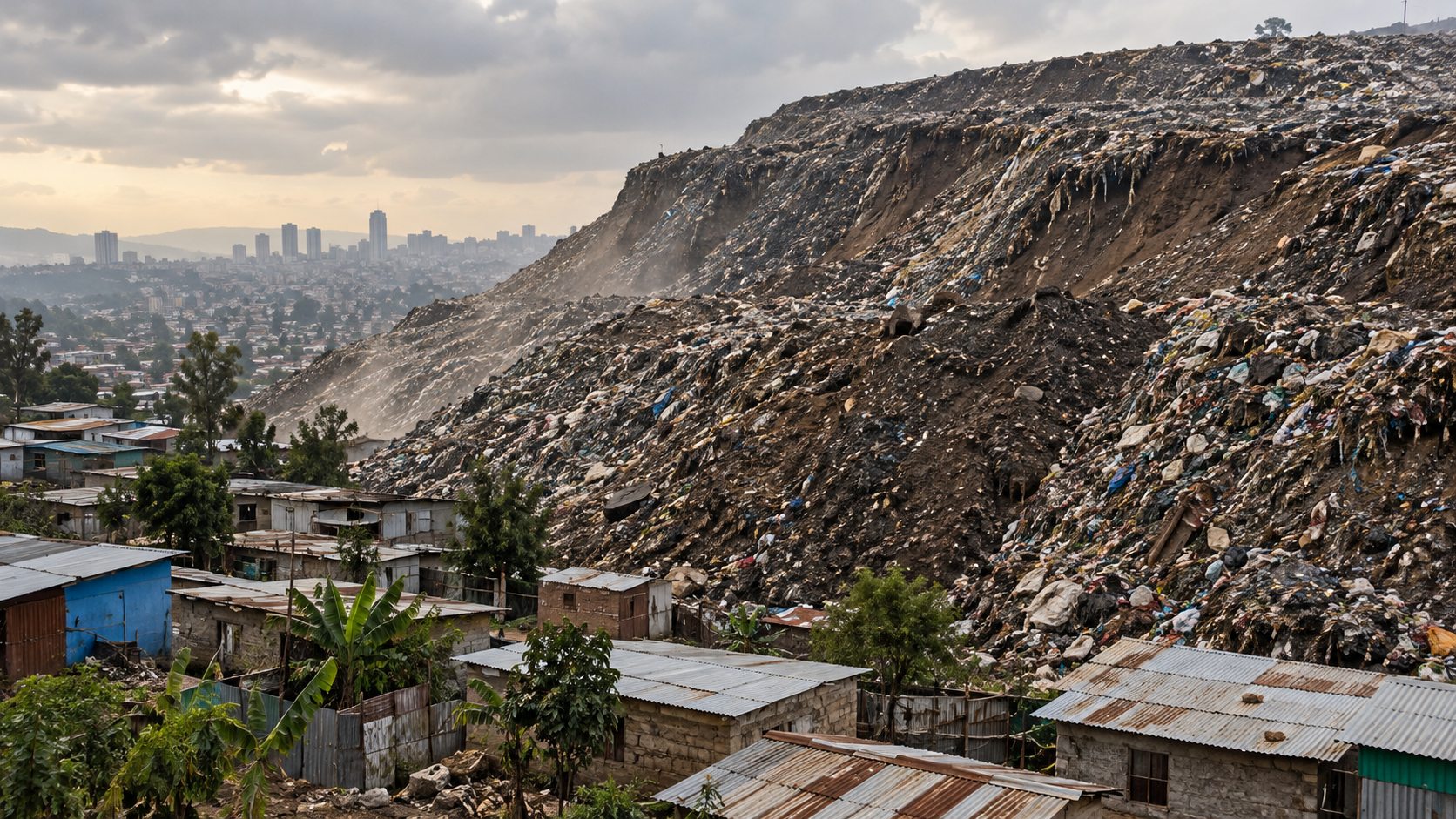
Editorial illustration, not documentary imagery.
On March 11, 2017, a massive mountain of accumulated garbage collapsed onto a residential settlement in Addis Ababa, Ethiopia. Dozens of homes disappeared beneath tons of decomposing waste, trapping families, children, and people who earned their living scavenging at the dump. The first reports counted 46 dead; later institutional accounts disagreed on the final toll. Years of dangerous landfill conditions, a failed relocation plan, and disputed construction activities raised questions about whether the disaster could have been prevented.
A Mountain of Garbage Collapses Without Warning
On the night of March 11, 2017, residents living beside Ethiopia's largest garbage dump heard a tremendous noise.
A massive section of the Koshe landfill, located on the outskirts of Addis Ababa, had begun collapsing.
The shifting mass of decomposing garbage, mud, and other waste swept downhill into a settlement where hundreds of people lived.
Houses constructed from wooden supports, corrugated metal, plastic sheeting, and other materials were buried.
Some stronger brick and concrete buildings were also destroyed.
Residents had almost no time to escape.
Musa Suleiman Abdulah, whose makeshift home was destroyed, told Agence France-Presse that the approaching debris resembled a tornado.
Another resident, Ibrahim Mohammed, estimated that the destruction unfolded in approximately three minutes.
By the time the avalanche stopped, entire sections of the settlement had disappeared.
People rushed toward the collapsed hillside looking for relatives.
Some survivors began digging through the garbage with their bare hands.
Others searched for recognizable pieces of clothing, household possessions, or sections of destroyed homes that might indicate where someone had been trapped.
The disaster had occurred in a place that had been receiving Addis Ababa's garbage for more than five decades.
The Reported Death Toll Rose and Diverged
On March 12, 2017, international news agencies reported that at least 46 people had died and dozens remained missing.
Addis Ababa city spokeswoman Dagmawit Moges said the initial victims included 32 females and 14 males, among them children.
Authorities warned that the number would rise.
About 150 people were believed to have been in the immediate area when the collapse occurred, according to an early resident estimate.
Mayor Diriba Kuma reported that 37 people had been rescued and were receiving medical care.
Rescue crews brought excavators to the site to dig through the collapsed material.
The search continued for days.
On March 15, Ethiopian authorities announced that the death toll had climbed to 113.
A government statement identified 75 female and 38 male victims.
By June 2017, Addis Ababa's administration was reporting 115 deaths.
In July 2019, the United Nations Human Settlements Programme, UN-Habitat, documented the disaster as having killed 116 people.
Other institutional material gave higher estimates. A UN-Habitat-hosted African Clean Cities Platform newsletter from 2019 described approximately 200 deaths. Japan's Ministry of Foreign Affairs wrote in a 2023 development white paper that more than 200 people died.
Those publications do not reconcile their higher estimates with UN-Habitat's separate figure of 116. The death toll should therefore be attributed to the source rather than presented as one universally accepted final count.
The changing and conflicting figures also illustrate how difficult the rescue and recovery operation became.
The avalanche did not simply bury people beneath loose soil. It trapped them within an unstable mixture of garbage that had accumulated and decomposed for decades.
Families Had Been Living on the Garbage Dump for Years
Koshe, also known as Repi or Reppi, was not simply a municipal landfill.
It was also a place where people worked, raised children, and established homes.
The dump had served Addis Ababa for more than 50 years.
By 2017, it covered more than 30 hectares and received substantial quantities of the city's solid waste.
An estimated 500 people worked there daily, sorting through discarded materials to find objects that could be sold or reused.
Scrap metal, plastic, and other recyclable materials provided income for workers who had limited alternative employment opportunities.
Some families also lived on or beside the landfill because housing nearby was relatively inexpensive.
The distinction between residents and waste pickers was not always clear.
Some people worked at Koshe during the day and returned to homes built along the edge of the same mountains of refuse.
Others had lived in the settlement for decades.
According to reporting by Voice of America, a woman identified as Werknesh had lived there for approximately 30 years.
She was away attending a funeral when the landfill collapsed.
When she returned, her house was buried.
Six family members, including her pregnant daughter and three grandchildren, had been killed.
The disaster destroyed more than property. It eliminated entire households and family networks.
The 16-Year-Old Who Wanted to Become an Engineer
Among those killed was Biniam Alemeneh, a 16-year-old student whose story was documented by Reuters.
Biniam lived near the landfill with his family.
His father, Tsegaye, worked in construction.
The teenager hoped to become an engineer, inspired by the modern buildings being constructed throughout Addis Ababa.
He wanted to attend university.
On March 11, the garbage mountain collapsed onto his neighborhood.
Biniam was buried.
Rescue workers recovered his body three days later.
His mother, Kassanesh, later showed Reuters a framed photograph of her son.
The family's experience illustrated how the landfill disaster extended beyond those who worked collecting discarded materials.
The settlement included children attending school, employed parents, and families attempting to improve their financial circumstances.
Biniam's father told Reuters that residents had repeatedly raised concerns about the landfill with city officials.
He believed authorities had failed to act on those warnings.
Smaller Garbage Landslides Had Already Happened
The 2017 collapse was not Koshe's first landslide.
Residents told journalists that smaller sections of the garbage mountain had collapsed during the preceding years.
Some earlier incidents had reportedly killed two or three people.
Workers and nearby residents were aware that the accumulated waste could shift.
The scale of the March disaster, however, was far greater.
Approximately 49 dwellings were reportedly destroyed.
The landfill had become particularly dangerous because waste continued accumulating over a large area without the same engineered controls used at modern sanitary landfill facilities.
Unlike solid rock or a properly designed earth embankment, a pile of decomposing refuse contains materials of different sizes, densities, and strengths.
Organic waste breaks down and changes its physical properties.
Water can enter the waste mass, increasing its weight and potentially weakening internal stability.
If the material accumulates in steep slopes, sections can begin moving under their own weight.
The collapse of one section can destabilize neighboring material.
UN-Habitat subsequently identified steep piles of continuously accumulated waste, decomposition, and inadequate water management as important hazards at the site.
The warning signs were therefore not limited to the neighborhood's proximity to a large amount of garbage.
The dump itself had a known history of smaller slope failures.
Why Was the Landfill Still Operating?
The Koshe landfill had been expected to close.
City officials had recognized for years that the site was approaching capacity.
A replacement landfill was developed outside Addis Ababa, and authorities attempted to redirect garbage there.
However, the replacement project encountered opposition from nearby communities.
Residents living around the proposed new dumping area raised concerns about environmental and health consequences.
The relocation plan stalled.
Garbage collection operations consequently continued or resumed at Koshe.
This meant that a site already associated with slope instability remained part of the city's waste-disposal system.
The surrounding population also continued living near the growing waste mass.
Amnesty International sharply criticized the government's handling of the situation following the collapse.
In a March 13 statement, the organization argued that authorities knew the landfill was operating beyond safe limits but had not adequately protected the people living and working beside it.
Amnesty called for a full investigation and adequate housing for displaced families.
That assessment addressed regulatory responsibility. It did not establish the exact physical event that triggered the avalanche.
Did Construction Work Cause the Garbage Avalanche?
In the days following the disaster, residents raised concerns about construction activity near the landfill.
A waste-to-energy development project was underway in the area.
Some witnesses alleged that bulldozers had been moving and compacting garbage near the top of the waste mountain.
Berhanu Degefe, a garbage collector interviewed by AFP, believed that heavy machinery associated with the project had increased pressure on the unstable slope.
Other residents suggested that renewed garbage dumping had contributed to the collapse.
The allegations were plausible enough to become an important part of early reporting.
However, there was no publicly established engineering finding proving that the construction project caused the disaster.
Government officials did not initially identify a definitive trigger.
In June 2017, Voice of America reported that authorities still had not determined the cause.
The distinction remains important.
A large landfill can fail because of several interacting factors, including its geometry, internal decomposition, changing water content, loading, and inadequate engineering controls.
Construction activity may create additional loading or disturb an unstable area, but identifying it as the actual trigger requires evidence.
The published reporting reviewed for this article does not establish that such a definitive determination was made.
A National Period of Mourning
As the death toll climbed, Ethiopia declared three days of national mourning beginning March 15, 2017.
Flags were lowered at government facilities, Ethiopian embassies, and other official locations.
Families gathered to bury relatives who had been recovered from the landfill.
The government established committees to assist affected residents and announced plans for relocation and compensation.
The mayor promised immediate financial assistance to bereaved families and longer-term resettlement.
However, the process was complicated.
Some survivors had lost identification documents and other possessions.
Others were unable to return to their homes because the land remained dangerous.
By June 2017, the city was distributing more than $4 million in government and private donations to survivors and affected families.
The assistance received mixed reactions.
One resident, Ersemo Balbamo, who lost three children and his property, told Voice of America that he was satisfied with the progress of his compensation.
Others complained about inadequate water supplies, sanitation facilities, and delays at temporary housing sites.
In July, Ethiopian newspaper The Reporter found approximately 90 survivors still living in a converted youth sports center while awaiting permanent housing.
Some residents also alleged that officials had pressured them after they spoke publicly about their living conditions.
Those allegations were reported by the newspaper but were not independently adjudicated in the available material.
For many survivors, the end of the rescue operation did not mean an immediate return to normal life.
The United Nations Helps Rebuild the Dangerous Landfill
After the disaster, the Addis Ababa administration requested assistance from UN-Habitat.
With support from the Japanese government, a rehabilitation project was developed to reduce the risk of further collapses.
The project used an approach known as the Fukuoka Method, a landfill engineering technique developed in Japan.
The method focuses on improving drainage and allowing air to move through the waste mass.
Instead of continuously building steep, unstable piles of decomposing garbage, the rehabilitation project reshaped dangerous areas, constructed more stable access routes, and installed systems to improve ventilation and water movement.
These improvements were intended to reduce erosion, internal heat, methane generation, and the risk of further slope failures.
According to UN-Habitat, the project had rehabilitated approximately 19 hectares of the landfill by July 2019.
Waste pickers interviewed by the agency reported improvements in working conditions.
One longtime worker, Bethlehem Belachew, said the smell had decreased and she felt safer working at the site.
The rehabilitation did not erase the original disaster or eliminate every risk associated with landfill operations.
It did demonstrate that engineering measures could significantly improve conditions at a site previously associated with deadly collapses.
Japan's Ministry of Foreign Affairs subsequently highlighted the Koshe rehabilitation as an example of international cooperation in waste management.
Why Garbage Landslides Are So Dangerous
A garbage landslide is different from a conventional slope failure involving rock or soil.
Municipal waste contains a complicated mixture of materials: food waste, plastics, paper, metal, construction debris, textiles, and countless other objects.
These materials respond differently when compressed or saturated.
Organic waste decomposes, generating heat and gas while its internal structure changes.
Rainwater or other liquids can accumulate inside poorly drained areas.
As large amounts of waste are deposited, the lower sections experience increasing pressure.
Where steep waste slopes are not adequately engineered, a sudden structural failure can release enormous amounts of material.
People living below such slopes face particularly serious danger.
Even if the initial movement is visible, a moving mass of waste can travel quickly enough to overwhelm nearby buildings.
Heavy machinery may also struggle to operate safely on unstable garbage during rescue operations.
The 2017 Koshe collapse demonstrated the consequences when waste accumulation and residential settlement exist in close proximity without sufficient safeguards.
Nine Years Later, the Koshe Disaster Remains a Warning
The catastrophe at Koshe occurred on March 11, 2017, but the conditions that made it dangerous had developed over decades.
The landfill had received Addis Ababa's garbage for more than half a century.
Workers depended on discarded materials for income.
Families lived along its unstable edges.
Smaller collapses had occurred before.
Plans to replace the dump had stalled.
When a large section finally gave way, the results were devastating.
The reported toll rose from 46 deaths in the first international reports to 113-116 in later Ethiopian government and UN-Habitat accounts. Other institutional publications have used estimates around or above 200.
The tragedy prompted compensation programs, resettlement efforts, national mourning, and engineering rehabilitation.
But important questions about the precise trigger and the adequacy of earlier safety measures were not resolved in the public reporting.
The most disturbing part of the Koshe disaster is that the deadly avalanche was made of something a city produces every day: ordinary household and commercial garbage.
After decades of accumulation, that waste had become a massive, unstable structure capable of destroying the homes and lives of the people living beside it.

Jude Cassian
Jude Cassian tracks the strange, dark, unexplained, and absurd corners of the world with independent curiosity and no political or religious spin.
Sources
Suggested Articles You Might Enjoy
AOC Discovers the Monster in Her Kitchen Sink: The Garbage Disposal Incident That Went Viral
A 2019 garbage disposal surprise went viral and reopened a strange chapter of New York City plumbing history.
PayPal Mafia
This unique group of former PayPal co-founders and employees has left an indelible mark on the technology industry
NFL's Worst Traumas: Unforgettable Injuries from 2000 Onward
In this article, we explore the worst NFL traumas from 2000 onward, examining devastating injuries that shook the league and left lasting impacts on players, teams, and fans.
Reference
https://www.scmp.com/news/world/africa/article/2078294/avalanche-garbage-kills-46-dozens-more-missing-horror-accident
Reference
https://www.cbsnews.com/news/dozens-killed-in-ethiopia-garbage-dump-landslide/
Reference
https://www.theguardian.com/world/2017/mar/12/rubbish-dump-landslide-kills-at-least-30-in-ethiopia
Reference
https://www.investing.com/news/world-news/buried-in-ethiopian-dump-landslide:-a-young-man-and-his-dream-467279
Reference
https://www.voanews.com/a/ethiopians-demand-answers-following-koshe-landslide-/3766972.html
Reference
https://ethiopianembassy.be/?p=8170
Reference
https://amnesty.ca/human-rights-news/ethiopia-government-failures-to-blame-for-dozens-of-deaths-at-rubbish-dump/
Reference
https://www.voanews.com/amp/ethiopia-trash-landslide-victims-receive-compensation/3897309.html
Reference
https://www.thereporterethiopia.com/355/
Reference
https://unhabitat.org/news/05-jul-2019/after-the-tragic-landslide-that-killed-116-koshe-landfill-in-addis-ababa-is-safer
Reference
https://www.mofa.go.jp/policy/oda/white/2023/html/takumi/takumi02.html
Reference
https://www.livescience.com/58307-what-caused-ethiopia-garbage-landslide.html
Reference
https://unhabitat.org/sites/default/files/2022-07/ACCP_Newsletter_vol4.pdf