
Haunted Homes Under Renovation: St. Louis Contractors Report Ghostly Figures, Moving Doors, and a Serious Ladder Accident
A St. Louis remodeler reported strange figures, lights, a moving attic door, and a serious ladder fall at two homes. Physical explanations remain unruled out.
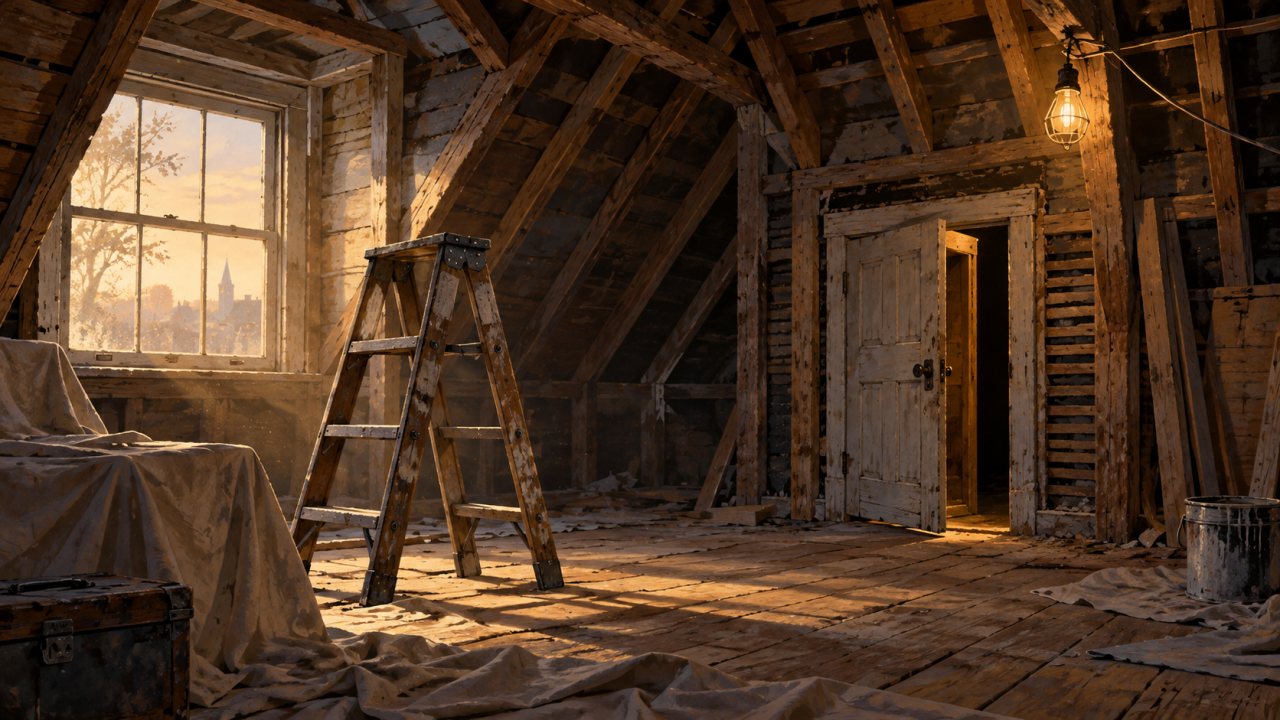
Editorial illustration, not documentary imagery.
Remodeling contractors encounter plenty of unexpected problems inside century-old houses. But workers from a St. Louis construction company reported something more unusual: figures that disappeared, lights that repeatedly went out, doors opening without anyone nearby, and a ladder accident that hospitalized a carpenter. The company documented the incidents in two homes whose owners also reported unexplained activity.
A Contractor's Account of Haunted Houses
St. Louis, Missouri, contains thousands of residential properties built during the late nineteenth and early twentieth centuries.
Some have undergone multiple renovations. Others retain their original basements, attics, staircases, and interior layouts.
For remodeling contractors, working in historic houses can mean discovering outdated wiring, concealed structural problems, and decades of undocumented alterations.
Occasionally, workers report experiences they cannot readily explain.
Mosby Building Arts, a St. Louis remodeling company established in 1947, published an article titled Mosby Ghost Stories: Remodeling in Haunted Homes, describing strange incidents encountered by its employees during two separate projects.
The company emphasized that the accounts were personal experiences rather than proof of paranormal activity. It also changed names and identifying details to protect the privacy of everyone involved.
The first incident involved an apparent human figure outside a South St. Louis home.
The second involved a series of incidents inside a historic house in Webster Groves, including a construction accident serious enough to require surgery.
A Figure Appears Beside a Basement Entrance
The first property was a century-old brick bungalow in South St. Louis.
Mosby had been hired to build a detached garage for the homeowners.
Most of the construction work took place in the backyard and alley, away from the main house. The crew initially encountered nothing unusual.
Before construction began, two members of the planning and design department visited the property to take measurements and photographs.
One employee, identified in the company's account as Betty, was measuring the back of the house during a summer day.
As she approached the stairs leading to the basement entrance, she experienced a sudden feeling of unease.
Then she noticed someone standing beside her.
The figure appeared in her peripheral vision. When she turned to look directly at it, nobody was there.
Betty initially assumed that her colleague, identified as Mike, had walked past her.
However, Mike was working elsewhere near the alley, measuring the garage area.
There was nobody immediately beside her.
The experience was disturbing enough that Betty refused to enter the basement. She asked Mike to complete those measurements instead.
The incident might have remained an isolated story if the homeowners had not subsequently mentioned something unusual about the house.
The Homeowners Reported Hearing Children Upstairs
During construction of the garage, Mosby's crew spoke with the homeowners.
According to the company's account, the homeowner casually mentioned that the house was haunted.
The family reported regularly hearing sounds resembling children playing upstairs.
The noises were apparently loud enough that the homeowners sometimes called upstairs for the children to quiet down.
The published account does not establish whether children were physically present in the home during those incidents or whether the sounds had another identifiable source.
When Betty heard about the homeowner's experiences, she connected them to the figure she believed she had seen outside the basement.
Her reaction suggested that she interpreted the incident as part of the same unexplained activity.
However, there was no documented investigation of the property, no photographic evidence of the apparent figure, and no independent identification of anyone who might have been standing beside her.
The garage project was completed without the company reporting any further incidents of comparable seriousness at that address.
Another House in Webster Groves
The second account involved a house in Webster Groves, a historic community in St. Louis County.
Webster Groves developed from several nineteenth-century communities along railroad routes and was incorporated in 1896.
Its older neighborhoods contain homes dating back more than a century.
Mosby Building Arts was performing extensive interior renovations on a house reportedly built on the grounds of a Civil War-era estate.
The company did not identify the property or provide documentation establishing its connection to the earlier estate.
What made this project unusual was a recurring problem with the lights.
During the early stages of construction, workers reported that lights repeatedly switched off in the rooms where they were working.
According to Mosby, the incidents happened frequently enough that the carpenters became accustomed to turning the lights back on and continuing their work.
When the crew mentioned the problem to the homeowners, the owners indicated that they were already familiar with unusual occurrences inside the building.
They reportedly acknowledged that other unexplained things happened there, although they avoided explicitly describing the property as haunted.
Then the incidents became more disturbing.
The Lights Go Out After Carpenters Criticize the House
Two carpenters, identified in the company's story as Tad and Van, were working in the basement.
While examining the existing construction, they began discussing the quality of some of the previous work.
They were openly critical of the craftsmanship.
Shortly afterward, the basement lights went out.
According to the account, the outage affected the basement rather than the entire building.
When the workers returned, the lights were functioning again.
The timing unsettled them.
The carpenters wondered whether something in the house had reacted to their criticism.
There was no evidence that anyone intentionally operated the switches, but the published account also did not identify an electrical inspection or establish that a wiring fault had been excluded.
A recurring electrical problem could account for lights failing unexpectedly.
Nevertheless, the workers interpreted the timing as unusual because similar incidents had reportedly occurred repeatedly during the renovation.
The next incident was considerably more serious.
A Ladder Suddenly Falls Sideways
While working alone in the attic, Tad positioned a ladder to reach part of the ceiling.
According to the company's account, he had used the ladder seven or eight times without difficulty.
He considered it stable.
During another ascent or period of work, the ladder unexpectedly moved sideways beneath him.
Tad fell to the floor and suffered a serious injury.
He required surgery and was unable to return to fieldwork for approximately two months.
While recovering in the hospital, he described the accident to colleagues.
What disturbed him was the direction in which the ladder moved.
Rather than sliding backward, as he expected an unstable ladder might, it moved sideways.
Tad described the movement as resembling a ladder being struck or kicked from the side.
He could not explain why it happened.
Because he had been alone in the attic, he did not believe another worker had physically interfered with the equipment.
The company included the accident in its collection of ghost stories because workers considered it part of the unexplained activity associated with the house.
However, the account does not establish that an outside force moved the ladder.
OSHA warns that portable ladders can move or slip when not safely positioned or secured. The direction of a fall alone cannot establish whether positioning, instability, or another cause was involved.
Without photographs of the setup, an equipment examination, or an accident investigation, the cause of Tad's fall cannot be independently established.
The company described a serious injury. Its suggested paranormal connection was an interpretation rather than a demonstrated cause.
An Attic Door Opens by Itself
Tad's accident was not the final unusual incident reported at the Webster Groves property.
While he was recovering, another member of the construction team was working alone in the same attic.
The carpenter heard a door slowly creaking.
He looked around to locate the sound and noticed that a small door built into a half-height wall was moving.
According to the account, the door slowly swung open.
The worker waited to see whether someone or something would emerge.
Nothing appeared.
No person was visible nearby, and the carpenter could not immediately explain the movement.
The published story did not establish whether the door had been securely latched, whether the house had functioning ventilation equipment that could affect air pressure, or whether movement from renovation work could have influenced its position.
Those details would matter when assessing a possible physical explanation.
Nevertheless, the incident became another unsettling experience for a crew already concerned about the frequent lighting failures and Tad's accident.
The Project Ends Just Before Halloween
Mosby reported that the Webster Groves renovation was completed shortly before Halloween.
The company did not specify the year.
By then, the crew had experienced repeated lighting problems, a serious ladder accident, and an attic door opening without an immediately apparent cause.
The homeowners had also suggested that unusual things happened inside their property.
According to the published account, workers were relieved when the project was finished.
There is no indication that the company brought in paranormal investigators or that the homeowners commissioned a scientific investigation into the reported activity.
There is also no documented evidence that the events continued after the renovation was completed.
Could Old Houses Explain Some of These Experiences?
Several reported incidents have potential physical explanations that should be considered before attributing them to paranormal activity.
Electrical problems: Older homes can have aging wiring, loose connections, overloaded circuits, or switches that malfunction intermittently. The Electrical Safety Foundation International identifies dimming and flickering lights as potential warning signs of electrical hazards.
Air pressure and drafts: Interior doors can move when airflow or pressure differences change inside a building. Heating and cooling systems, open windows, and poorly balanced ventilation can affect airflow between rooms.
Structural movement: Older buildings can develop loose hardware, uneven doors, shifting framing, or other conditions that produce unexpected sounds and movements.
Construction hazards: Remodeling introduces vibrations, changing loads, temporary equipment, and movement through areas not normally occupied. OSHA documents the risks of unsecured or improperly positioned ladders, including lateral movement and falls.
These explanations do not establish what happened inside either Mosby project.
They demonstrate that apparently inexplicable events can have physical causes that are not immediately obvious to someone experiencing them.
The reported figure outside the basement is more difficult to assess because there is no recording or independent observation available.
A brief peripheral-vision experience does not establish the presence of an actual person or apparition.
Likewise, hearing noises resembling children playing does not establish their source.
Why the Accounts Remain Unverified
The Mosby stories are unusual because they were published by an established remodeling business rather than an anonymous paranormal discussion forum.
The company had employees involved in the projects and described experiences that it attributed to members of its own crew.
That makes the source identifiable and accountable for what it published.
However, independent verification remains limited.
Mosby expressly changed names and identifying details. The company did not disclose the addresses, construction dates, accident reports, medical documentation, or electrical inspection findings.
Consequently, researchers cannot reliably connect the incidents to specific houses or independently reconstruct what occurred.
The available evidence supports the conclusion that Mosby publicly reported these stories.
It does not establish that ghosts were responsible for any of the events.
Two Renovations, Several Unanswered Questions
The two projects involved different properties and different kinds of reported experiences.
At the South St. Louis bungalow, an employee believed she saw a person standing beside her, while the homeowners described hearing children upstairs.
At the Webster Groves house, employees encountered repeated lighting failures, an unexplained door movement, and a serious ladder accident.
Both accounts included homeowners who reportedly acknowledged unusual activity.
Neither case produced publicly available physical evidence demonstrating a paranormal cause.
The most consequential event was the attic accident, because the carpenter reportedly required surgery and spent approximately two months away from fieldwork.
Whatever caused the fall, it was a serious occupational incident rather than merely an unsettling experience.
The Mosby accounts leave one question unanswered: Were the workers encountering ordinary but unfamiliar problems inside aging buildings, or did they experience events that available physical explanations have not accounted for?
Without independent investigations, the question remains open. What can be established is that the company publicly documented the incidents and that its workers regarded them as some of their most unusual remodeling experiences.

Jude Cassian
Jude Cassian tracks the strange, dark, unexplained, and absurd corners of the world with independent curiosity and no political or religious spin.
Sources
Suggested Articles You Might Enjoy
The Haunted Boiler of Eldon House: A Repairman Encounters Disappearing Shoes Inside Canada's Historic Mansion
A 2005 Eldon House boiler repair led to reports of sudden physical sensations and vanishing shoes. The alleged diary connection remains unverified.
Canada's Haunted Caribou Hotel: Contractors Report Ghostly Footsteps, Strange Lights, and a Woman Who Died in 1933
At Yukon's Caribou Hotel, restoration workers reported lights without utility power, empty-staircase footsteps, and camera glitches. The haunting remains unverified.
Red Laser DMT, Alien Glyphs, and Simulation Code
A skeptical look at the viral 650 nm red-laser DMT claim, the reported alien glyphs, and why neuroscience and optics explain more than simulation-code speculation.
Reference
https://mosbybuildingarts.com/mosby-ghost-stories-remodeling-in-haunted-homes/
Reference
https://mosbybuildingarts.com/about-us/our-history/
Reference
https://www.webstergrovesmo.gov/137/Area-History
Reference
https://www.wgpl.org/webster-groves-homes/
Reference
https://www.osha.gov/etools/construction/falls/
Reference
https://www.osha.gov/etools/construction/falls/ladder-safety
Reference
https://www.esfi.org/home-wiring-safety-tips/
Reference
https://www.electricalsafetyfirst.org.uk/press-and-media/tech-experts-debunk-haunted-house-signs/
Reference
https://bsesc.energy.gov/energy-basics/hvac-ducted-returns